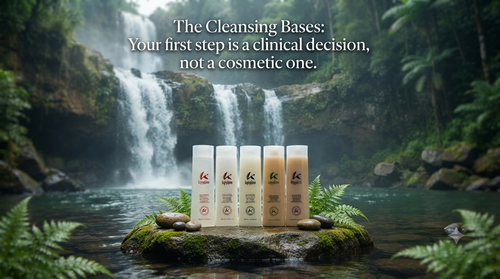
The Cleansing Bases: Your First Step Is a Clinical Decision, Not a Cosmetic One.
The Cleansing Bases:
Your First Step Is a Clinical Decision,
Not a Cosmetic One.
Most professionals treat the shampoo as the step before the real treatment starts. The Kapyderm system treats it as the first therapeutic intervention. The cleanser you choose determines the pH environment, the microbiome state, and the follicle receptivity of every active ingredient that follows. Here is the clinical science behind all five bases — and the decision tree that maps each one to a specific scalp condition.
The Kapyderm Dermotricology line includes five condition-specific cleansing bases — Normalizing, Hair Loss, Dry Scalp, Dandruff, and Oily Hair Wash — each formulated to address a distinct scalp type and clinical scalp condition. All five are pH 5.0-balanced, SLS-free (SLES-based — ethoxylated and milder than SLS, explained in full below; note SLES is still a sulfate, so these are SLS-free rather than sulfate-free), EU-regulated, and formulated to be microbiome-compatible. The selection is a clinical decision: the wrong base disrupts the scalp environment before a single active is applied. This article provides the peer-reviewed science behind each base, the verified INCI for all five, and a complete protocol decision tree for certified Technicians of Dermotricology.
- The pH problem no competitor is talking about
- SLS: what the clinical evidence actually shows
- The scalp microbiome and why your cleanser shapes it
- The five cleansing bases — clinical profiles
- Protocol decision tree — which base for which condition
- Competitor comparison — the honest assessment
- How to explain cleanser selection to your clients
- Frequently asked questions
The pH Problem No Competitor Is Talking About
The scalp is skin. Like facial skin, it has a tightly regulated acid mantle — a thin, slightly acidic film that maintains the microbiome, activates ceramide-processing enzymes, and protects the stratum corneum from pathogenic colonization. The clinical literature is unambiguous: the ideal scalp pH is between 5 and 6.[1]
Now consider what most shampoos on the market actually measure. An analysis of 123 commercially available shampoos found that 61.78% had a pH above 5.5 — and among anti-dandruff shampoos specifically, 80.77% were above 5.5. Plain soap reaches pH 11. There is no mandatory pH standard for shampoo anywhere in the world, which is why the figure varies so widely between products that look equivalent on the shelf.[14]
Peer-reviewed evidence published in the Journal of Clinical and Aesthetic Dermatology confirms that high pH induces swelling of the stratum corneum, disrupts the microenvironment for commensal microbes, and inhibits the enzymatic systems that process ceramide precursors — the same ceramide-processing enzymes that maintain barrier integrity and limit TEWL.[1] This is not a theoretical concern. It means that every time a client washes with an alkaline formula, the scalp's repair capacity is working against a headwind — before a single active ingredient from the protocol is applied. High-throughput sequencing has confirmed that shampoo choice alone measurably changes scalp microbiome composition over a course of use.[15] The cleanser is either working with the scalp's biology or against it. There is no neutral option.
The Kapyderm cleansing bases are formulated at pH 5.0 to match the scalp's natural acid mantle — not as a marketing claim, but as a clinical requirement for the rest of the Dermotricology protocol to function at full efficacy. A scalp prepared at the correct pH is a different biological environment than one that has just been washed with an alkaline SLS-based formula. The downstream impact on ampoule penetration, tonic absorption, and follicle receptivity is real and measurable.
SLS vs. SLES: What the Clinical Evidence Actually Shows — and Why the Distinction Matters
Before the evidence: a distinction the professional hair care market almost never explains clearly. There are two sulfate surfactants commonly discussed in scalp care — Sodium Lauryl Sulfate (SLS) and Sodium Laureth Sulfate (SLES). They are not the same ingredient. The peer-reviewed clinical concerns documented below apply specifically to SLS. The Kapyderm cleansing bases use SLES — a chemically distinct, ethoxylated alternative that does not carry the same documented adverse profile. To be precise about it: SLES is still a sulfate surfactant. These bases are SLS-free, not sulfate-free, and the article says so rather than blurring the two.
Sodium lauryl sulfate is the primary cleansing surfactant in a large share of shampoos on the market, professional lines included. It creates rich lather and removes oil effectively. It also does several things the brands using it are not advertising.
Microbiome disruption: Research published in the Journal of Clinical and Aesthetic Dermatology (2023) states that SLS-containing products destroy the microbiome and dry the skin in patch tests.[1] The scalp microbiome is not cosmetically inconvenient — it is the functional environment in which every active ingredient in the Dermotricology protocol operates.
Follicular deposition: Autoradiographic studies using radiolabeled SLS found heavy deposition of the surfactant on the skin surface and in the hair follicles themselves. The Cosmetic Ingredient Review safety assessment concluded that cosmetic products applied to skin should not contain SLS concentrations above 1% due to its potential to deposit on hair follicles and produce comedones.[5] That threshold applies to leave-on products; shampoos are rinse-off, but the deposition finding is still the reason to prefer a milder surfactant for daily use.
Rebound sebum production: Aggressive stripping of scalp sebum with harsh cleansers triggers compensatory sebaceous gland activity. For K2 oily scalp clients, this creates a cycle: strip → rebound → strip again. The result is a scalp that appears oily faster than before the client started using the product.[1]
TEWL and wash frequency: Research published in the International Journal of Trichology (2024) measured scalp transepidermal water loss against hair wash frequency and found a significant relationship — TEWL being the primary clinical indicator of barrier damage.[9] A scalp with elevated TEWL is losing moisture continuously, regardless of how many hydrating products are applied topically. Related work measuring scalp sebum, pH, TEWL and barrier function across scalp regions confirms these are trackable, changeable parameters rather than fixed traits.[3]
When a certified Technician of Dermotricology sends a client home with an SLS-based "professional" shampoo — regardless of brand — they are prescribing a product that works against the microbiome between every in-center visit, and that triggers sebum rebound in oily scalp types. The choice of home cleanser is not a retail decision. It is a clinical decision that determines how much of the in-center protocol's work holds before the next appointment.
The Scalp Microbiome and Why Your Cleanser Shapes It
The scalp hosts a complex microbiome of bacteria, fungi, and viruses that is intrinsically tied to hair and scalp health. This ecosystem is influenced by pH, sebum production, environmental factors, and — critically — the cleansing products applied to it daily.[6] A 2025 high-throughput sequencing study tracked scalp microbiome composition through a course of shampoo use and confirmed the effect is direct and measurable, not theoretical.[15]
Healthy scalps demonstrate higher ratios of Cutibacterium — bacteria that metabolize sebum triglycerides into short-chain fatty acids, helping maintain scalp pH and barrier function.[1] Dandruff-affected and seborrheic dermatitis scalps show elevated Malassezia restricta and Staphylococcus, while androgenetic alopecia scalps demonstrate overall microbiome dysbiosis that correlates with the degree of follicular miniaturization.[8]
A 2025 randomized controlled study published in Dermatology and Therapy confirmed that sustained clinical improvement in seborrheic dermatitis required microbiome rediversification — specifically, increasing fungal and bacterial richness while decreasing Malassezia and Staphylococcus dominance.[7] The maintenance cleanser used between intensive treatment phases was critical to sustaining these microbiome shifts. An antimicrobially aggressive or pH-disruptive cleanser in the home-care phase can reverse the microbiome improvements achieved in-center. This is why the selection of the correct Kapyderm cleansing base for home use is inseparable from the in-center protocol's clinical outcomes.
The Five Cleansing Bases — Clinical Profiles
The foundation of the Dermotricology home-care system — used when no single condition dominates the clinical picture or when beginning a new client protocol before scalp evaluation results are complete. The Normalizing Base Wash establishes the pH-balanced, microbiome-compatible cleansing environment that makes every subsequent active treatment more effective.
The β-glucocerebrosidase mechanism: At the correct acidic pH (5–5.5), the enzyme β-glucocerebrosidase processes ceramide precursors in the stratum corneum — maintaining the lipid barrier that limits TEWL and pathogenic penetration. Alkaline shampoos inhibit this enzyme system with every wash. The Normalizing Base Wash preserves it. Every wash is a therapeutic step, not a cleansing interruption.
Used in the Normalizing protocol as the daily home-care cleanser between in-center visits. Also the correct base for clients transitioning from a standard SLS-based shampoo — the first 2–3 weeks of use allows the scalp microbiome to begin rebalancing before condition-specific targeted bases are introduced.
The daily home-care anchor for every androgenetic alopecia protocol. The rationale draws on the perifollicular environment argument: sebum accumulation near the follicle opening is proposed to hold DHT and inflammatory mediators in prolonged contact with the follicle, compounding the androgen-driven miniaturization that characterizes AGA.[11]
The DHT mechanism: In AGA, 5α-reductase converts testosterone to DHT in hair follicles, particularly in frontal and vertex regions. DHT binding suppresses the Wnt/β-catenin pathway critical for follicle renewal, promotes TGF-β release, and progressively miniaturizes the follicle.[10] The Hair Loss Wash addresses the part of that picture a cleanser can reach: gentle, consistent sebum regulation without the rebound overproduction triggered by stripping cleansers.
A 2025 multi-kingdom sequencing study confirmed that the scalp microbiome in AGA patients shows dysbiosis compared to healthy controls, with microbial imbalance correlating with the degree of follicle miniaturization.[8] The Hair Loss Wash's microbiome-compatible formula supports the bacterial diversity that the AGA scalp is losing.
This is not a retail anti-hair-loss shampoo. Retail products add caffeine, biotin, or saw palmetto to a standard SLS base and call it a hair loss solution. The Hair Loss Wash is a daily maintenance step in a complete protocol — its value depends on consistent use within the broader Dermotricology system, not as a standalone product.
What the formula brings that a generic cleanser does not: Hydrolyzed Keratin with confirmed cortex penetration,[20] Panthenol with documented biomarker effects in cultured dermal papilla cells,[18] and Sodium Hyaluronate — in a cleanser designed for a 3–10 minute dwell. The instruction to leave on for 3–10 minutes after the second application is meaningful rather than cosmetic: that is the contact window in which these actives interact with the scalp surface and follicle opening.
Formulated for the K1 scalp type — characteristically dry, flaky without the Malassezia-driven component of seborrheic dermatitis, with elevated TEWL and compromised stratum corneum hydration. The Dry Scalp Wash is the only cleansing base in the line where the primary goal is not to reduce sebum — it is to cleanse without further compromising the barrier that is already failing to retain moisture.
The TEWL clinical context: TEWL is the primary clinical indicator of scalp barrier damage — measuring the amount of water diffusing through the stratum corneum to the skin surface per unit of time.[12] Research published in the International Journal of Trichology (2024) found a significant relationship between hair wash frequency and scalp TEWL.[9] For a barrier-compromised scalp, that makes both the formula and the frequency clinical variables rather than preferences.
For dry scalp clients, the cleanser selection is arguably the most important protocol decision — because the barrier damage driving their condition is being reinforced daily by the wrong home cleanser. Switching to the Dry Scalp Wash is the first structural intervention, before any tonic or cream is applied.
Formulated for Malassezia-driven seborrheic dermatitis and dandruff — the most clinically complex condition in the Dermotricology cleanser portfolio. The peer-reviewed evidence on this condition has advanced significantly: a 2025 multi-omics analysis confirmed that dandruff scalps show elevated Malassezia restricta and Staphylococcus while healthy scalps demonstrate higher Cutibacterium and Ascomycota abundance.[6]
Why conventional anti-dandruff shampoos often fail long-term: Current therapies — ketoconazole, selenium sulfide, zinc pyrithione — provide relief but frequently fail to produce durable outcomes because they reduce Malassezia populations without restoring the broader microbiome diversity that prevents re-establishment.[4] A 2025 randomized controlled study in Dermatology and Therapy confirmed that sustained improvement required microbiome rediversification — not just antimicrobial suppression.[7] Notably, the same principle holds for piroctone olamine: a 94-subject metagenomics study found it reduced Malassezia restricta and Staphylococcus capitis with measurable pathway-level microbiome change.[17] The argument is not that antifungals do not work — it is that the maintenance phase needs a formula that supports diversity rather than suppressing it.
A May 2026 study published in Microorganisms provides direct evidence for the plant-based botanical cleanser approach. A 12-week intervention using a shampoo containing herbal extracts — ginger root, Polygonum multiflorum, and Platycladus orientalis leaf — produced significant clinical improvement in seborrheic alopecia patients: reduced hair loss, reduced scalp sebum content, and restoration of microbial diversity to levels comparable to healthy controls, with normalization of Staphylococcus and Malassezia abundances.[16] A separate 2025 study of a synergistic herbal formulation targeting Malassezia furfur and Staphylococcus epidermidis reached compatible conclusions on botanical antimicrobial activity.[13]
A 2025 cohort study of 20 patients with moderate-to-severe seborrheic dermatitis treated with a pH-correcting cleanser system reported 80% overall clinical improvement at 16 weeks — with significant reductions in dandruff score, itchiness, erythema, and greasiness measured at 4 weeks (all p<0.01).[2] The maintenance cleanser phase following intensive treatment was identified as critical to sustaining these results — mirroring the Kapyderm in-center plus home maintenance protocol architecture.
Formulated for the K2 oily scalp type — where excess sebum production creates the substrate for Malassezia proliferation, accelerates follicle congestion, and produces the greasy, flat appearance that drives clients to wash more frequently with increasingly aggressive formulas. The clinical irony of the oily scalp type: the more aggressively they wash, the oilier the scalp becomes.
The rebound mechanism: Harsh anti-sebum shampoos strip scalp sebum below the sebaceous gland's regulatory threshold — triggering compensatory overproduction. The scalp appears greasier within 24–48 hours of washing because the glands are producing more oil to replace what was stripped. Research confirms that sarcosine — an amino acid derivative — selectively reduces sebum on the scalp without triggering rebound, while simultaneously increasing microbial diversity over time.[1] The Oily Hair Wash is designed to break the cycle: reducing sebum through selective botanical regulation rather than stripping, allowing the K2 scalp to normalize its output over time rather than cycling between extreme states.
For high-frequency washers — clients who wash daily or multiple times per week due to activity levels — the Oily Hair Wash is also the correct daily formula, because its surfactant system supports the scalp through repeated cleansing without the cumulative microbiome disruption that harsh daily washing produces, and without the stripping-rebound cycle that drives K2 clients to over-wash.
Protocol Decision Tree — Which Base for Which Condition
The selection framework below maps each cleansing base to the scalp presentation, clinical priority, and protocol context. Use this as the reference guide for home-care recommendation at the end of each in-center visit.
→ Normalizing Base Wash
- First in-center visit before full Kapykon evaluation is complete
- Transitioning client from SLS-based shampoo — allow 2–3 weeks to begin microbiome rebalancing
- No single dominant condition — mixed presentation requiring baseline stabilization first
- General scalp maintenance between condition-specific protocol phases
→ Hair Loss Wash
- Androgenetic alopecia — male or female pattern hair loss
- Diffuse thinning with confirmed or suspected DHT component
- Perifollicular sebum accumulation visible on trichoscopy
- Any AGA protocol where microbiome-protective daily cleansing is a priority
- Post-partum telogen effluvium with androgenetic predisposition
→ Dry Scalp Wash
- K1 scalp type — consistently dry, flaky, and tight regardless of season
- Flaking without erythema or greasiness — distinguishes from seborrheic dermatitis
- Client reports scalp feels worse after every wash — classic elevated TEWL presentation
- Post-chemical treatment or color damage presenting as scalp dryness
- Concurrent use with Dry Scalp Tonic and barrier-repair cream protocol
→ Dandruff Hair Wash
- Malassezia-driven seborrheic dermatitis — erythema + flaking + itch
- Dandruff with greasy, yellowish or white adherent flakes
- Microbiome dysbiosis — elevated Malassezia and Staphylococcus
- Maintenance phase following intensive in-center SD protocol
- Clients who have previously used ketoconazole or zinc pyrithione shampoos with recurrence
→ Oily Hair Wash
- K2 oily scalp type — sebum visible within 24 hours of washing
- Client washes daily or multiple times per week and scalp still appears oily
- Post-workout scalp care — multiple washes per week without microbiome disruption
- Oily scalp with concurrent mild dandruff — Malassezia feeds on excess sebum; reducing sebum addresses both
- Clients coming off aggressive anti-dandruff shampoos with rebound sebum overproduction
Four additional variables every certified Technician should factor into cleanser selection
Competitor Comparison — The Honest Assessment
Competitor formulas change without notice, so the row below describes each brand's general approach and the surfactant class typically used at the time of writing — not a claim about the current formulation of any specific SKU. Check a current label before repeating any of it to a client.
| Brand / Product | Approach | Surfactant class | pH-Balanced | Condition-Specific | Microbiome consideration |
|---|---|---|---|---|---|
| Nioxin Systems 1–6 | Hair density by "system" number (fine/thick, natural/treated) — not scalp condition-mapped | Conventional sulfate surfactant base | Not stated as pH-targeted | Hair type only — not scalp condition | Not a stated formulation goal |
| Philip Kingsley (Flaky/Itchy, Density) | Symptom-driven — addresses surface symptoms, limited condition specificity | Piroctone olamine + conventional surfactant base | Not stated across full range | Symptom-only — no scalp type framework | Piroctone olamine has published microbiome data[17] |
| Aveda Invati (Advanced) | One formula for all hair loss types — salicylic acid exfoliation + botanical actives | Babassu-derived cleansing agents | Not stated as pH-targeted | Single formula — no condition differentiation | Not a stated formulation goal |
| Head & Shoulders / Neutrogena T/Sal | OTC — symptomatic control, pyrithione zinc or salicylic acid for dandruff | Conventional sulfate surfactant base | Not stated as pH-targeted | Single active ingredient — no scalp type framework | Antifungal suppression without rediversification[4] |
| CeraVe Hydrating Shampoo | Consumer dry scalp — ceramides + niacinamide in a standard shampoo base | Sulfate-free surfactants | Not stated | Single formula — no clinical condition mapping | Sulfate-free is a positive; no microbiome data published |
| Kapyderm Cleansing Bases (5) | 5 condition-specific bases — each addressing a distinct scalp type and clinical mechanism | SLES at pH 5.0 — SLS-free (still a sulfate), ethoxylated and milder than SLS, EU-regulated | Yes — pH 5.0, matched to the scalp's acid mantle | Yes — K1/K2 scalp type + condition-specific (AGA, SD, dry, oily) | Yes — pH and surfactant chosen to be microbiome-compatible. Note: formulas do contain Parfum and a preservative (see each INCI above) |
How to Explain Cleanser Selection to Your Clients
The most common client resistance when recommending a specific Kapyderm wash: "I already have a shampoo I like — can I just keep using that at home?" Here is a professional framework you can adapt:
"The shampoo you use at home is not just a cleansing product in our protocol — it is the daily step that either maintains or undermines what we are doing in the treatment room. Think of it this way: if we spend an hour supporting your scalp's microbiome and barrier function in here, and then you go home and wash with a shampoo that works against both every day, a significant amount of that work is being reversed between appointments."
"Your scalp's ideal pH is between 5 and 6. When researchers tested 123 shampoos on the market, more than 60% came in above that range — and among anti-dandruff shampoos it was over 80%. There is no rule requiring a shampoo to state its pH, so you genuinely cannot tell from the bottle. That difference is not cosmetic — it affects whether the enzymes your scalp uses to repair its barrier are working normally."
"The [specific wash] I am recommending for you is formulated for [your scalp condition — e.g., androgenetic thinning / seborrheic dermatitis / dry scalp]. It cleanses without disrupting your microbiome, without stripping your sebum below the level your scalp needs, and without raising your scalp's pH above the range it works best in. It is not just a better shampoo — it is the first step of your home protocol, every day."
If they push back on price vs. their current shampoo: "Consider what you are already spending on the appointment every few weeks. The home-care cleanser is what determines how much of that holds between visits. Using the wrong shampoo at home is the equivalent of taking two steps back for every step we take forward in here."
Frequently Asked Questions
- Leoty-Okombi S, et al. New Topicals to Support a Healthy Scalp While Preserving the Microbiome: A Report of Clinical and in Vitro Studies. Journal of Clinical and Aesthetic Dermatology. 2023. Scalp pH 5–6 evidence; SLS microbiome effects; S. epidermidis barrier function; sebum-selective regulation via sarcosine. jcadonline.com
- Ge L, et al. A Cohort Clinical Study on the Efficacy of Topical Salicylic Acid/Piroctone Olamine Dandruff Pre-Gel and Cleanser in Improving Symptoms of Moderate to Severe Seborrheic Dermatitis of the Scalp. Journal of Cosmetic Dermatology. Jan 2025. n=20; 80% overall clinical improvement at 16 weeks; dandruff, itchiness, erythema, greasiness all p<0.01 at 4 weeks; maintenance cleanser sustains results. PMC11705510
- Wang Q, et al. SSA-ZP on Scalp Seborrheic Dermatitis: Regulating Sebum Levels and Scalp Barrier. Journal of Cosmetic Dermatology. 2024 Oct. TEWL, pH, sebum and barrier function measured across forehead, crown and occiput — scalp parameters as trackable variables. PMC11743326 · doi: 10.1111/jocd.16617
- Vano-Galvan S, et al. Seborrheic Dermatitis: From Microbiome and Skin Barrier Involvement to Emerging Approaches in Dermocosmetic Treatment. MDPI Cosmetics. 2024. Conventional antifungals provide temporary relief; Malassezia and Staphylococcus; dermocosmetic goal is restoring barrier function. doi: 10.3390/cosmetics11060208
- Cosmetic Ingredient Review (CIR). Safety Assessment of Sodium Lauryl Sulfate and Ammonium Lauryl Sulfate. Regulatory safety assessment, not a peer-reviewed study. SLS follicular deposition; comedone formation; recommendation against >1% SLS in leave-on products. cir-safety.org
- Lin Q, et al. Dysbiosis and Genomic Plasticity in the Oily Scalp Microbiome: A Multi-Omics Analysis of Dandruff Pathogenesis. Frontiers in Microbiology. 2025. Malassezia restricta and Staphylococcus elevated in dandruff scalps; Cutibacterium higher in healthy scalps; pH and sebum influence on microbiome. PMC12271121
- Scalp Microbiome Dynamics Can Contribute to the Clinical Effect of a Novel Antiseborrheic Dermatitis Shampoo: A Randomized Controlled Study. Dermatology and Therapy. June 2025. Microbiome rediversification; Malassezia and Staphylococcus decrease; maintenance cleanser phase critical to sustained outcomes. doi: 10.1007/s13555-025-01408-z
- Wang Y, et al. Microbial Dysbiosis and Its Diagnostic Potential in Androgenetic Alopecia: Insights from Multi-Kingdom Sequencing and Machine Learning. June 2025. Scalp microbiome dysbiosis in AGA correlates with follicle miniaturization; age-correlated microbiome trends disrupted in AGA patients. PMC12172500
- Etnawati K, et al. Measurements of Scalp Transepidermal Water Loss and Hydration in Women Wearing Hijab: Correlation with Hair Wash Frequency. International Journal of Trichology. 2024. Relationship between hair wash frequency and scalp TEWL / hydration. Note: this study examines wash frequency, not surfactant type. Int J Trichology 16(1–6):16-24 · doi: 10.4103/ijt.ijt_61_22
- Zhang J, et al. Updates in Treatment for Androgenetic Alopecia. Annals of Dermatology. Dec 2025. DHT and Wnt/β-catenin pathway suppression; TGF-β and follicle apoptosis; perifollicular environment as a modifiable factor in AGA. doi: 10.5021/ad.25.042
- American Hair Loss Association. The No-Wash Fallacy: How Scalp Neglect Amplifies DHT Damage and Accelerates Hair Loss. March 2025. Advocacy organisation article, not peer-reviewed research. Argues sebum accumulation holds DHT and inflammatory mediators near the follicle opening; Malassezia proliferation link. americanhairloss.org
- Levine JM, et al. Clinical Measurement of Transepidermal Water Loss. Advances in Wound Care. 2025. TEWL as primary indicator of barrier damage; measurement methodology across anatomical sites. PMC12359141
- Singh R, et al. A Synergistic Herbal Formulation Targeting Malassezia furfur and Staphylococcus epidermidis for Effective Dandruff Management. 2025. Plant-based botanical antimicrobial activity against dandruff-associated microorganisms. PMC12679390
- Gavazzoni Dias MF, et al. The Shampoo pH Can Affect the Hair: Myth or Reality? International Journal of Trichology. 2014. 123 commercially available shampoos analysed: 61.78% above pH 5.5; anti-dandruff shampoos 80.77% above pH 5.5; scalp pH 5.5, hair shaft pH 3.67; no mandatory pH standard exists. PMC4158629
- Li X, et al. High-Throughput Sequencing to Analyze Changes in the Human Scalp Microbiome During the Use of a Shampoo. BMC Microbiology. Aug 2025. Shampoo choice directly and measurably changes scalp microbiome composition over a course of use. PMC12337528 · doi: 10.1186/s12866-025-04260-5
- Chen X, et al. Scalp Microbiota Dysbiosis in Seborrheic Alopecia and Restoration Following Herbal Extract Shampoo Intervention. Microorganisms. May 2026. 12-week herbal shampoo intervention (ginger root, Polygonum multiflorum, Platycladus orientalis); microbial diversity restored to healthy control levels; Staphylococcus and Malassezia normalized. doi: 10.3390/microorganisms14051106
- Hu P, Henry J, Tiesman JP, et al. Scalp microbiome composition changes and pathway evaluations due to effective treatment with Piroctone Olamine shampoo. International Journal of Cosmetic Science. 2024;46:333–347. 94-subject metagenomics study; 0.5% POL shampoo reduced Malassezia restricta and Staphylococcus capitis; quantified microbiome pathway changes. doi: 10.1111/ics.12933
- Kim JE, et al. Dexpanthenol promotes cell growth by preventing cell senescence and apoptosis in cultured human hair follicle cells. Cosmetics. 2022;9(3):97. In vitro study. Cultured dermal papilla cells: ALP +40%, VEGF +70%, TGF-β1 -30%, Ki67 increased, Caspase 3/9 reduced. PMC8929036 · doi: 10.3390/cosmetics9030097
- How KN, et al. Open-label clinical study on the effectiveness of a moisturizer containing tocotrienol-rich composition in children with mild to moderate atopic dermatitis. Journal of Cosmetic Dermatology. 2023. Skin study in children with atopic dermatitis — not a scalp study. Topical vitamin E (tocotrienol-rich): 49.7% TEWL reduction, 17.4% erythema improvement at 12 weeks. doi: 10.1111/jocd.15793
- Bian X, et al. Performance and mechanism of hydrolyzed keratin for hair photoaging prevention. Molecules. March 2025;30(5):1182. SEM confirmed cortex penetration; tensile strength maintained in keratin-treated hair vs. 14.32% loss in untreated hair under UV exposure. PMC11902160 · doi: 10.3390/molecules30051182
20 sources. Eighteen are peer-reviewed studies or reviews; reference 5 is a regulatory safety assessment and reference 11 is an advocacy organisation article — both are labelled as such above. Several cited studies are in vitro or on skin rather than scalp, and are noted individually. Last reviewed August 19, 2026.
Order the Kapyderm Cleansing Bases for Your Center
All five cleansing bases are available through the certified Kapyderm center network. Contact your Kapyderm USA representative to order or restock.
Contact Your Rep →Join the Network. Get Access to the Full Dermotricology Line.
The complete Kapyderm Dermotricology product system — including all five cleansing bases — is available to certified centers. Get in touch to find out what certification involves.
Ask About Certification →