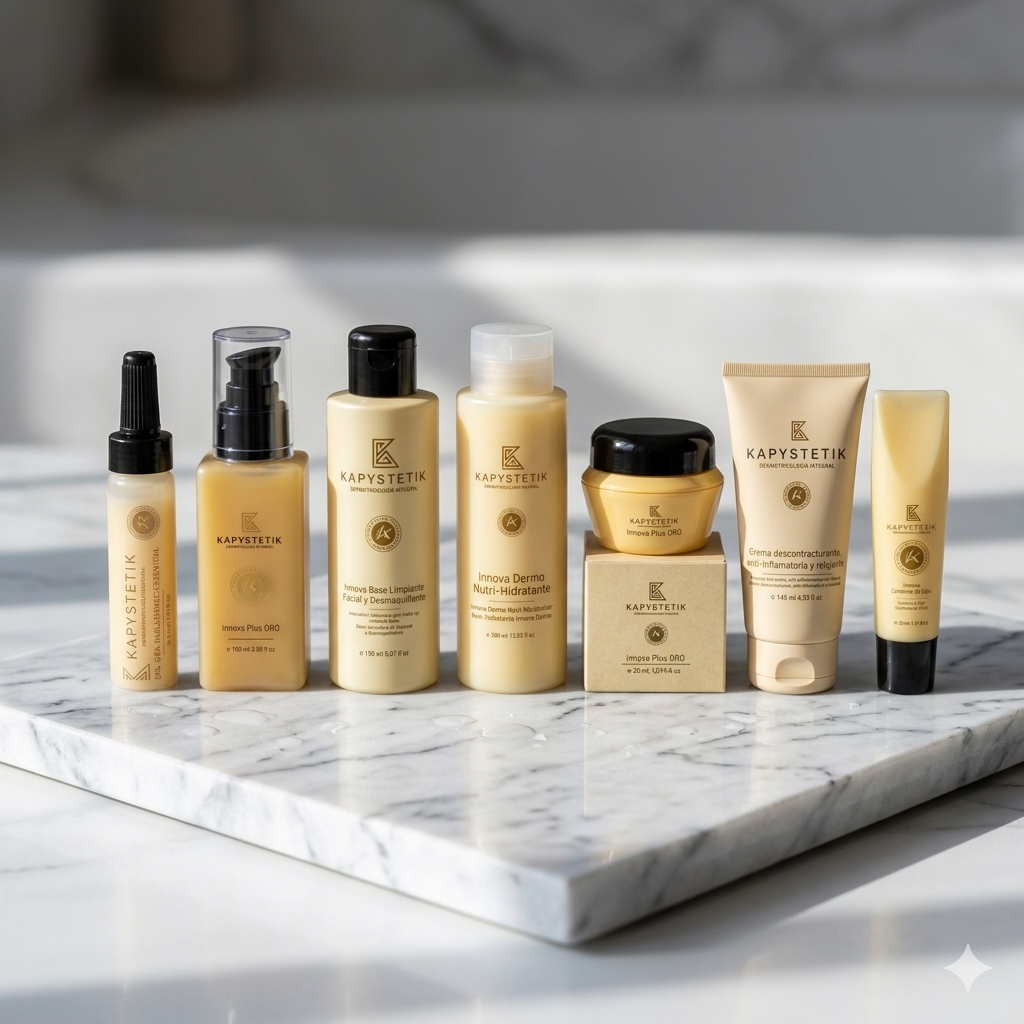
Skin aging is a biological process with specific, measurable mechanisms. Collagen production declines gradually from the mid-20s. The skin's moisture-binding capacity decreases with every decade. Elastin fibres lose structural integrity. Sebum production slows, leaving the barrier more exposed to environmental stress.
Understanding these mechanisms changes how you choose skincare. The useful question is not "which product has the best marketing?" but "which ingredients address the mechanism behind my concern?" Plant-based formulas make a particular kind of sense here — botanical lipids are structurally close to the skin's own, and formulas built around them tend to be better tolerated by skin that reacts badly to stronger actives.
1%
Collagen production is commonly estimated to decline by around 1% per year from the mid-20s — accelerating after menopause. By the 40s, volume loss, fine lines and reduced firmness reflect years of accumulated change. The realistic goal is to support and slow that process, not reverse it.
1. What Plant-Based Anti-Aging Skincare Does Differently
The argument for plant-based skincare is biochemical rather than sentimental. The lipid structure of many plant oils closely mirrors the skin's own sebum composition, which is part of why they are absorbed readily and are generally well tolerated.
What strong actives do over time
Retinol — the most widely recommended anti-aging active in U.S. dermatology — works by accelerating cellular turnover, and it has substantial clinical evidence behind it. The trade-off is tolerance: at higher concentrations or with frequent use it can compromise the barrier, increase sensitivity and sun reactivity, and cause irritation that some people cannot sustain. The same trade-off applies to glycolic acid and stronger chemical exfoliants.
Plant-based formulas take a different route. Rather than driving the skin to turn over faster, they supply the materials the skin uses for its own renewal — structural peptides, hydration, antioxidant support, and lipids for the barrier. Results tend to build more gradually, and tolerance is generally better.
| Factor | Strong synthetic actives | Plant-based Dermotricology |
|---|
| Primary mechanism | Drives accelerated cell turnover | Supplies materials for the skin's own renewal |
| Clinical evidence base | Strong — retinoids in particular have extensive trial data | Growing — good evidence for individual actives, fewer head-to-head trials |
| Barrier impact | Can compromise the barrier at higher concentrations or frequency | Formulated to support barrier function |
| Tolerance over time | Irritation and sun sensitivity are common limiting factors | Generally well tolerated, including on reactive skin |
| Biocompatibility | Variable by molecule | High — botanical lipids mirror the skin's own structure |
| EU regulatory position | Permitted, several under concentration limits | Permitted; formulated within the same framework |
| Suitable for sensitive skin | Often not — irritation risk | Yes — chosen for compatibility |
2. What EU Cosmetic Regulation Actually Means
The difference between a product made in Europe and one made in the United States is not marketing — it is a regulatory difference that affects what may legally go into the bottle.
Under EU Regulation (EC) No 1223/2009, the European Union prohibits or restricts well over a thousand substances in cosmetics, requires a documented safety assessment for every finished product before it goes on sale, and mandates labelling of specified fragrance allergens. The U.S. framework has historically restricted a considerably shorter list. That gap is real, and it matters most for people whose skin reacts.
What this means for Kapystetik
Every Kapystetik product is manufactured in Spain by Laboratorios Kapyderm under EU Regulation (EC) No 1223/2009. That means the formulas are built within the EU's restricted-substance framework and each product carries a documented safety assessment before sale. It is a higher regulatory floor — not a guarantee about any individual result.
01
Skin concern
Fine Lines & Expression Wrinkles
Driven by collagen loss, repeated muscle movement, and UV degradation of elastin
Fine lines are usually the earliest visible sign of intrinsic aging — typically appearing in the late 20s around the eyes and mouth, and deepening through the 30s and 40s. They form where two processes meet: collagen decline reducing the dermis's volume and resilience, and elastin degradation reducing the skin's ability to spring back after movement.
UV radiation accelerates both, breaking down collagen and elastin through free radical generation in the dermis. Which is why sun protection is structural rather than cosmetic: every unprotected day compounds the rate at which lines form.
The key ingredients
Broken into small peptide fragments. Applied topically it works mainly at the surface — holding moisture and forming a smoothing film that improves the look of fine lines. For collagen's structural role in the dermis, oral supplementation has the better evidence
Vitamin C (L-Ascorbic Acid)
An essential cofactor for collagen synthesis — fibroblasts cannot form stable collagen without it. It also neutralizes free radicals generated by UV exposure, which is where much of its anti-aging value lies
High in tocopherols (Vitamin E) and essential fatty acids — provides lipid nourishment that supports the skin's surface and helps counter the oxidative stress associated with collagen breakdown. ⚠ Contains wheat-derived lipids; patch test if you have a wheat allergy
A plant-derived astringent with soothing and antioxidant properties — calms surface irritation and temporarily tightens the look of fine lines
Recommended for fine lines & wrinkles
02
Skin concern
Loss of Firmness & Elasticity
Driven by elastin degradation, collagen volume loss, and facial fat pad changes
Firmness depends on two structural proteins working together: collagen for tensile strength and volume, elastin for the snap-back that lets skin return to position. As both decline, skin loses the taut appearance of youth — showing along the jawline, in the mid-face, and in deepening nasolabial folds.
This is the concern where topical-only approaches have the clearest limits, since much of what produces sagging happens in the deeper dermis and in the fat pads beneath it. Topical care can improve surface quality and the appearance of firmness; it does not reposition tissue.
The key ingredients
Hydrolysed elastin fragments act as humectants and film-formers at the surface, improving suppleness and the look of resilience. ★ Verify the INCI source on this product before describing it as plant-based
Derived from olive oil, squalane is structurally close to the skin's own squalene. It restores surface lipids without clogging pores, giving skin the supple, cushioned quality that reads as firmness
At the surface, collagen peptides bind water and smooth texture. Paired with oral collagen, the two work at different levels — one on how skin looks today, the other on the dermal matrix over months
An alpha-hydroxy acid produced by fermentation. At low concentrations it gently supports surface renewal without the sting of stronger acids, improving texture and the fresh, plump look of the surface
Recommended for loss of firmness
The complete at-home lifting system
Botanical Micro-Lifting Home Treatment — plant-based clinical formulas for the appearance of firmness, tone and elasticity
Get the system →
03
Skin concern
Dehydration & Moisture Loss
Driven by declining NMF, reduced sebum production, and barrier impairment
Dehydration is distinct from dryness: it is a moisture deficit in the epidermis, not a lack of oil. Even oily skin can be dehydrated. As skin ages, Natural Moisturizing Factor — the amino acids, urea and lactic acid the skin produces itself — declines, reducing its capacity to hold water. The result is a dull, tight, crepey look that surface moisturizer alone doesn't fully resolve.
The key ingredients
The sodium salt of hyaluronic acid, with a smaller molecular weight that allows better penetration into the upper epidermis. It binds many times its weight in water, supporting hydration below the surface rather than only on it
Hyaluronic Acid (multi-weight)
High molecular weight HA sits at the surface and forms an immediate moisture film, reducing transepidermal water loss, while lower molecular weight fractions work slightly deeper for more sustained hydration
Topical collagen forms a film at the skin surface that reduces transepidermal water loss. Combined with hyaluronic acid it gives a dual-action hydration effect — one holding water, the other slowing its escape
A lipid close in structure to the skin's own sebum, squalane seals the barrier without heavy occlusion — helping hold in the moisture the humectants have drawn in
Recommended for dehydration & moisture loss
04
Skin concern
Hyperpigmentation & Dark Spots
Driven by melanin overproduction, post-inflammatory pigmentation, and UV exposure
Age spots, sun spots and post-inflammatory pigmentation share a mechanism: localized overproduction of melanin by melanocytes in the basal layer. UV exposure is the primary trigger, prompting melanocytes to produce melanin as a protective response. Over decades this produces the dark patches on face, hands and décolleté that are among the clearest signals of cumulative sun exposure.
A plant-based approach works on two fronts: moderating melanin production and supporting surface turnover to bring through clearer skin — without hydroquinone or high-strength peels.
See a doctor about any changing spot
Cosmetic brightening is for even tone, not for diagnosing pigment. Any spot that changes in size, shape, colour or border, bleeds, or looks different from your others should be examined by a dermatologist before you treat it with anything. Skin cancer can present as a dark patch, and no cosmetic product addresses it.
The key ingredients
Inhibits tyrosinase, a key enzyme in melanin synthesis, reducing new pigment formation, while neutralizing the UV-generated free radicals that drive melanocyte overactivity in the first place
Gentle surface renewal that helps bring through more even-toned skin, without the irritation risk of stronger acids or the barrier disruption of aggressive peels
No brightening routine works without it. Every unprotected day re-triggers melanocyte activity and undoes the work. Daily sun protection is the foundation of any pigmentation routine, not an optional extra
Support surface condition and hydration alongside the actives above — well-hydrated skin tolerates a brightening routine considerably better than dry, compromised skin does
Recommended for hyperpigmentation & dark spots
05
Skin concern
Skin Barrier Damage — Sensitivity, Redness & Dryness
Driven by lipid depletion, aggressive products, and environmental stress
The skin barrier is the most underappreciated structure in skincare — regulating moisture retention, limiting irritant penetration, and maintaining the acid mantle that keeps the skin microbiome in balance. When it is compromised by over-exfoliation, harsh cleansers, environmental stress or aggressive actives, the result is irritation, sensitivity and reactivity.
A significant amount of barrier damage is caused by anti-aging products themselves — high-concentration retinol, strong glycolic acid, and daily chemical exfoliation are the usual culprits, producing quick results while depleting the lipid layer that long-term skin health depends on.
The key ingredients
Rich in essential fatty acids and tocopherols, supplying lipid material that supports barrier repair. ⚠ Wheat-derived — patch test if you have a wheat allergy
Forms a breathable, non-occlusive film that shields compromised skin from environmental irritants while letting it recover. Unlike heavy occlusives it doesn't interfere with the skin's own renewal
At the surface, collagen's film-forming and water-binding action helps a compromised barrier hold moisture while it repairs
Lactic Acid (low concentration)
At low concentrations lactic acid is itself an NMF component — increasing the skin's own moisture-binding capacity while supporting gentle renewal. Mild enough for compromised skin when stronger acids are not
Recommended for barrier damage & sensitivity
The Kapystetik Anti-Aging Range
Every Kapystetik product is manufactured in Spain under EU Regulation (EC) No 1223/2009. Here is the range mapped to its primary function:
Fine lines · Uneven tone · Hydration
The complete at-home anti-aging protocol — works on the look of lines, firmness, tone and radiance through plant-based botanical formulas
Shop Anti-Aging Treatment →
Firmness · Elasticity · Radiance
Firming and toning system supporting the appearance of elasticity and definition through plant-based formulas for the surface dermis
Shop Micro-Lifting Treatment →
Rejuvenation · Nourishment · All ages
Bioactive formula delivering deep nourishment and supporting skin renewal
Bioactive botanicals · Plant-based actives
Shop Innova Plus Gold →
Fine lines · Hydration · Firmness
Hydrating anti-aging treatment for the look of fine lines, dehydration and reduced firmness
Hyaluronic Acid · Collagen · Vitamin C
Shop Hyaluronic Essential →
Crow's feet · Dark circles · Puffiness
Eye cream for the appearance of fine lines, puffiness and dark circles at the most delicate skin zone
Collagen · Elastin peptides
Shop Eye Contour →
Cleansing · Barrier support · All skin types
Deep-cleansing formula that removes makeup and balances the skin without stripping the barrier
Lactic Acid · Collagen · pH-balancing botanicals
Shop Face Wash →
Body barrier support · Very dry skin
Rich body moisturizer for very dry, dehydrated and sensitive skin that needs more than a standard lotion
Nourishing botanicals · Barrier lipids
Shop Body Cream →
When Should You Start? A Decade-by-Decade Framework
The most common mistake in anti-aging skincare is starting late — waiting until lines are deep before building a routine. The biology begins in the mid-20s, which is a long way before most people act.
20s
Prevention — Establish the Foundation
Collagen production has already begun its slow decline. Priorities: daily broad-spectrum sun protection, antioxidant support against UV-generated free radicals, and a cleanser that doesn't compromise the barrier. The Innova Face Wash covers the last of those without aggression.
30s
Early Correction — Address First Signs
Fine lines around the eyes and mouth become visible and the dermis is less plump than in the 20s. Add the Innova Skin Hyaluronic Essential (Hyaluronic Acid + Collagen + Vitamin C) for hydration and antioxidant support. The Innova Eye Contour addresses the eye zone specifically.
40s
Active Support — Target Firmness
Reduced firmness and deeper lines become the primary concerns. This is where the Micro-Lifting Home Treatment fits, or the Anti-Aging Home Treatment for the full range of concerns in one protocol.
50s+
Maintenance — Inside and Out
Hormonal changes accelerate collagen and sebum decline. A combined approach makes the most sense here — oral collagen support alongside the topical Kapystetik routine, and daily sun protection without exception.
Frequently Asked Questions
QIs plant-based skincare as effective as retinol?
They are different tools. Retinoids have the strongest clinical evidence base of any topical anti-aging active, and for someone whose skin tolerates them well they are hard to beat on wrinkle reduction. The catch is tolerance: irritation, dryness and sun sensitivity are common, and a meaningful number of people cannot sustain use. Plant-based actives — collagen and elastin peptides, sodium hyaluronate, Vitamin C, squalane — work more gradually and are generally much better tolerated, which makes them a better fit for reactive or barrier-compromised skin, and for anyone who has tried retinol and stopped. If retinol suits your skin, it is a reasonable choice; if it doesn't, gradual is better than nothing.
QWhat is the best natural anti-aging ingredient?
There isn't a single one — the more effective routines combine ingredients targeting different mechanisms. For the look of lines: collagen peptides and Vitamin C. For hydration: sodium hyaluronate with multi-weight hyaluronic acid. For suppleness: squalane. For preventing pigmentation and further collagen loss: daily sun protection, which does more than any active. The Innova Skin Hyaluronic Essential combines hyaluronic acid, collagen and Vitamin C in one formula.
QWhen should I start anti-aging skincare?
Earlier than most people think — the mid-20s is reasonable. Collagen production begins its gradual decline around then, and by the time fine lines appear in the early 30s the dermis has already changed. Starting with prevention — daily sun protection, antioxidants, a gentle cleanser — means working with skin that is still robust rather than trying to correct years of accumulated change.
QIs EU skincare better than US skincare?
On ingredient restriction and pre-market safety assessment, the EU framework is more demanding. It prohibits or restricts well over a thousand substances and requires a documented safety assessment for every finished product before sale. That doesn't make every EU product superior or every US product unsafe — plenty of excellent skincare is made in the US. It does mean an EU-made product has cleared a more rigorous ingredient screen. Kapystetik products are made in Spain by Laboratorios Kapyderm within that framework.
QWhat is the difference between hyaluronic acid and sodium hyaluronate?
Sodium hyaluronate is the sodium salt form of hyaluronic acid, smaller in molecular weight and better able to penetrate the upper epidermis. Standard high molecular weight hyaluronic acid stays at the surface and forms a moisture film that reduces water loss. The most effective formulas use both, for surface and slightly deeper hydration at once — which is what the Innova Skin Hyaluronic Essential does.
QCan plant-based skincare work for mature skin over 50?
It suits mature skin particularly well, because mature skin is often more sensitive and barrier-compromised than younger skin and tolerates aggressive actives less easily. Botanical lipids, peptides and multi-weight hyaluronic acid address the specific reality of post-menopausal skin — reduced sebum, reduced moisture retention, thinner barrier — without the irritation risk of strong acids or high-concentration retinol. Pairing the topical routine with oral collagen addresses the surface and the dermal matrix at the same time.
QDo I need a separate eye cream?
Usually yes, and not for marketing reasons. The skin around the eye is considerably thinner than facial skin, has fewer oil glands, and takes constant mechanical stress from blinking and expression. It is where signs of aging tend to show first, and standard facial moisturizers formulated for thicker skin can be too heavy there — sometimes causing milia or puffiness. The Innova Eye Contour is formulated for that zone specifically.
QWhat order should I apply my skincare products?
Thinnest to thickest, letting each absorb before the next. Morning: Innova Face Wash → Innova Eye Contour → Innova Skin Hyaluronic Essential → sun protection. Evening: Innova Face Wash → Innova Eye Contour → Innova Plus Gold or Innova Skin Hyaluronic Essential. Cleanser first so nothing sits between the actives and your skin; sun protection always last in the morning so its film stays intact on the surface.
References
- Reilly DM, Kynaston L, Naseem S, Proudman E, Laceby D. (2024). A clinical trial shows improvement in skin collagen, hydration, elasticity, wrinkles, scalp, and hair condition following 12-week oral intake of a supplement containing hydrolysed collagen. Dermatology Research and Practice, 2024, 8752787. PubMed 39021368
- Papakonstantinou E, Roth M, Karakiulakis G. (2012). Hyaluronic acid: a key molecule in skin aging. Dermato-Endocrinology, 4(3), 253–258. doi: 10.4161/derm.21923
- Pullar JM, Carr AC, Vissers MCM. (2017). The roles of vitamin C in skin health. Nutrients, 9(8), 866. doi: 10.3390/nu9080866
- European Commission. Regulation (EC) No 1223/2009 on cosmetic products. Official Journal of the European Union. EUR-Lex
This article is general information about skincare and is not medical advice. Individual results vary. See a dermatologist about any skin condition, or any spot that is changing.