The Hidden Epidemic: The Real Issues Women Experience with Hair Loss—And the Cellular Solution
The Hidden Epidemic:
Scalp Micro-Inflammation & the Real Issues Women Experience with Hair Loss
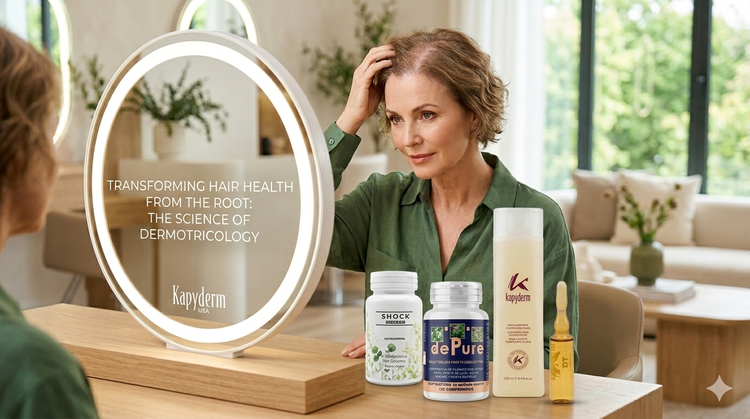
For millions of women, hair loss is far more than a cosmetic inconvenience. It is an exhausting, deeply emotional experience that touches self-image, confidence, and daily life. Whether you wake up to find your pillow coated in strands, or notice a wider, more visible part line, female hair thinning can feel isolating — and confusing.
Confusing because the standard explanations don't always fit. Your bloodwork is normal. Your thyroid is fine. There's no dramatic stress event to point to. And the hair keeps falling. One factor that often goes unexamined in that situation is scalp micro-inflammation — a low-grade inflammatory process in the tissue around the follicle that can produce no visible surface symptoms at all.
1. The 2026 Research on Perifollicular Inflammation
In January 2026, researchers published a study in Clinical, Cosmetic and Investigational Dermatology that adds real weight to something Dermotricology practice has worked on for years: the tissue environment around the follicle matters in pattern hair loss, not just the hormone.
Researchers analyzed 129 androgenetic alopecia patients, using high-magnification imaging to guide biopsies from both thinning and normal-appearing scalp. They identified a follicle-centered inflammatory and early fibrotic pattern — perifollicular infundibulo-isthmic lymphocytic infiltrates and fibrosis, or PIILIF — in normal-appearing scalp in 81% of patients. It was more common in patients aged 44 or older, at advanced stages of loss, and in those with prior poor response to standard treatment. Among evaluable patients treated for both the hormonal driver and the follicle-centered inflammation, 67% improved.
If you have used minoxidil consistently without much result — or seen results fade over time — the perifollicular environment is worth considering. Minoxidil works on blood flow to the follicle. It is not designed to address inflammation in the tissue around it. The 2026 study found that treating both the hormonal driver and the inflammation together produced better outcomes than standard treatment alone. Minoxidil is an FDA-approved OTC drug and worth discussing with your doctor; a scalp protocol is a separate, complementary question.
2. Five Contributors to Scalp Micro-Inflammation in Women
Female hair thinning is usually driven by several factors converging rather than one — each capable of starting the process, and each compounding the others when present together. Understanding which apply to you is where any useful response starts.
Estrogen has anti-inflammatory effects and helps suppress the inflammatory signaling involved in perifollicular inflammation. When estrogen drops — postpartum, in perimenopause, or at menopause — that buffering effect lessens. The follicle environment is then more exposed to inflammatory signals from DHT, oxidized sebum, and microbial imbalance at the same time.
This is part of why thinning so often coincides with hormonal transitions — not because the hormones themselves destroy follicles, but because their withdrawal removes a protective buffer.
Chronic stress drives sustained cortisol release, which among other effects alters the scalp microbiome. Malassezia overgrowth in turn contributes to the inflammatory response associated with seborrheic flaking and perifollicular irritation. Cortisol also pushes active follicles into telogen earlier — shortening the growth phase and increasing daily shedding independently of the inflammatory route.
The body classifies hair as non-essential tissue. When nutritional resources run short — through restricted eating, malabsorption, pregnancy demands, or metabolic shifts — nutrients are diverted away from follicles to protect vital organs first. A nutritionally depleted follicle is less able to withstand inflammatory signals it would otherwise tolerate. Iron deficiency is among the most common and most under-recognized contributors to female hair loss. Ask your doctor for bloodwork before supplementing iron — supplementing without a deficiency is not harmless.
The scalp hosts a complex ecosystem of bacteria and yeasts that, in balance, support barrier function and keep inflammation low. Malassezia species — principally M. globosa and M. restricta — occur naturally on every scalp and feed on sebum. When the ecosystem is disrupted by hormonal change, stress, aggressive shampoos, or environmental factors, they can overgrow, producing free fatty acids that penetrate the scalp barrier and provoke an inflammatory response in susceptible people.
DHT — dihydrotestosterone — is a primary driver of androgenetic alopecia in women as well as men, though women produce it at lower levels. As estrogen declines and the estrogen-to-androgen ratio shifts, even normal DHT levels can exert a miniaturizing effect on genetically susceptible follicles. What the 2026 research adds is that the hormonal and inflammatory pathways are not separate stories: an inflammatory pattern was present alongside the hormonal driver in most of the patients studied, and addressing both together outperformed addressing the hormone alone.
3. The Inflammatory Cascade: How Follicular Asphyxiation Happens
Whichever trigger starts the process, female hair thinning often shares a similar sequence at the scalp level, culminating in what Dermotricology calls follicular asphyxiation — the progressive suffocation of the hair root. This is a Dermotricology framework for describing the process, not a formal medical classification.
Steps 1 through 5 typically produce no visible symptoms on the surface of the scalp. No redness. No itching. No obvious flaking. That is why it usually goes unnoticed until step 6 — visible shedding — or step 7 makes it undeniable, by which point the process has often been running for months. Acting earlier generally produces better outcomes than waiting for clear signs. If you are seeing thinning, a dermatologist can rule out the medical causes that need medical treatment.
4. Why Single-Pathway Treatments Often Plateau
The 2026 research offers a plausible explanation for why many women who do everything right — consistent minoxidil, good diet, stress management — still see progressive thinning. Standard treatments are built around a single pathway, while the process described above runs on several at once.
| Approach | What it addresses | What it doesn't reach | Why progress can plateau |
|---|---|---|---|
| Minoxidil | Blood flow to the follicle — vasodilation | Perifollicular inflammation, DHT, microbiome, nutrition | Supports blood flow while other processes continue unaddressed. FDA-approved OTC drug — discuss with your doctor |
| Finasteride / Spironolactone | DHT and androgen pathway | Inflammatory pathway, microbiome balance, nutrition | Prescription medicines that work on the hormonal driver; the 2026 study found adding anti-inflammatory treatment improved on hormonal therapy alone |
| Biotin supplements | Biotin deficiency, which is uncommon | Inflammation, DHT, iron, Vitamin D, microbiome | Most people are not biotin deficient — extra biotin offers no established benefit for those who aren't |
| Generic anti-dandruff shampoo | Surface Malassezia, temporarily | Perifollicular inflammation, microbiome balance, follicle nutrition | Reduces the yeast without changing the environment that allowed overgrowth, so it returns when the product stops |
| Kapyderm Dermotricology protocol | The scalp environment and internal contributors together — sebum, microbiome balance, barrier, and nutritional support | Medical diagnosis and prescription treatment — this is cosmetic care and works alongside your doctor, not instead of them | Built as an ongoing routine rather than a short course; consistency is what holds results. Individual results vary |
5. The Dermotricology Response — Working Across the Cascade
The Dermotricology approach to female hair thinning works on the scalp environment and the internal contributors together rather than one at a time. That means a layered routine, not a single product.
| Cascade step | What it targets | Kapyderm protocol |
|---|---|---|
| Sebum oxidation + congestion | Normalize sebum, clear follicle openings | Oily Scalp Wash + Seboregulator Tonic |
| Malassezia overgrowth | Support microbiome balance without stripping the scalp | Fungi Activ + Dandruff Wash |
| Perifollicular irritation | Soothe the follicle environment | Alogenic Tonic + Base Tonic |
| Follicle congestion | Support delivery to the hair bulb | Ampoule DT, applied topically as part of an in-centre or home protocol |
| DHT sensitization | Plant-based 5-alpha reductase modulation | Kapynatura 5-Alpha-R — Epilobium 400mg + saw palmetto |
| Nutritional depletion | Iron, zinc, biotin, Vitamin D — after bloodwork | Shock Ecology + Revital |
| Cortisol-driven imbalance | Support the stress response | Kapynatura Anti-Stress |
| Systemic inflammatory load | Botanical liver and digestive support | Kapynatura dePure |
Not everyone needs the full protocol at once. The Kapyderm Hair Loss Home Treatment is the most accessible starting point — a dual-action system pairing the topical scalp protocol with internal support, covering the most common steps in one package. For more advanced thinning, a scalp evaluation with a certified specialist gives you a protocol built around what your scalp actually shows — alongside, not instead of, a dermatologist's assessment.
6. Frequently Asked Questions
- Umar S, Tan BH, Shitabata PK. (2026). Perifollicular inflammation and fibrosis in androgenetic alopecia: implications for diagnosis and treatment — a comparative histopathologic and clinical study with normal-appearing scalp. Clinical, Cosmetic and Investigational Dermatology, 19, 548520. doi: 10.2147/CCID.S548520
- Plante J, Valdebran M, Forcucci J, Lucas O, Elston D. (2022). Perifollicular inflammation and follicular spongiosis in androgenetic alopecia. Journal of the American Academy of Dermatology, 86(2), 437–438. doi: 10.1016/j.jaad.2021.09.040
- Whiting DA. (1993). Diagnostic and predictive value of horizontal sections of scalp biopsy specimens in male pattern androgenetic alopecia. Journal of the American Academy of Dermatology, 28(5), 755–763. PubMed 8496421
- Okwundu N, et al. (2022). Seborrheic dermatitis as a potential inflammatory trigger in central centrifugal cicatricial alopecia: a systematic review. Journal of the American Academy of Dermatology. PubMed
This article is general information about scalp and hair care and is not medical advice. Hair loss can have medical causes that need medical diagnosis and treatment — see a doctor. Individual results vary.
Work on the inflammation
your other treatments aren't reaching.
The Kapyderm Hair Loss Home Treatment is a plant-based clinical protocol built to work on the scalp environment — sebum, microbiome balance and follicle congestion — alongside internal support for the DHT pathway and nutrition. Together, not one at a time.