The Ultimate Guide to Reclaiming Hair Density: Overcoming Thinning Hair in Older Women
Thinning Hair in Perimenopause, Menopause & Beyond:
The Clinical Guide to Treatment & Regrowth

A widening part line. A lighter ponytail. More hair in the shower drain than you've ever noticed before. These are not signs of aging gracefully — they are clinical signals that four simultaneous biological processes are disrupting your hair follicle environment. And unlike what most women are told, these changes are neither inevitable nor irreversible — when addressed with the right clinical protocol at the right time.
The challenge is that women experiencing menopausal hair thinning are typically offered two options: minoxidil (which compensates for the problem without addressing it) or "wait and see" (which allows preventable follicle damage to compound over time). This guide gives you a third option — a Dermotricology clinical framework that addresses the actual biological mechanisms driving the change.
1. The Four Biological Drivers of Menopausal Hair Thinning
Menopausal hair thinning is not a single condition — it is the convergence of four distinct biological mechanisms operating simultaneously. Treatments that address only one of them produce partial, temporary results. Addressing all four is what produces lasting density restoration.
| Driver | Mechanism | What you notice | Kapyderm response |
|---|---|---|---|
| Estrogen decline | Estrogen extends the anagen (growth) phase — as it drops, follicles spend more time resting and less time growing | Increased daily shedding, shorter hair length, reduced volume | Alogenic Tonic — follicle reactivation; Kapynatura Shock Ecology |
| Unopposed androgens (DHT) | As estrogen falls, the estrogen-to-androgen ratio shifts — DHT miniaturizes follicles progressively | Widening part at crown, pattern thinning at top of scalp | Kapynatura 5-Alpha-R — plant-based DHT inhibition |
| Collagen loss | Estrogen supports collagen synthesis — its decline accelerates dermis thinning and weakens the follicular support structure | Hair becomes finer, more fragile, loses diameter | Kapynatura Colágeno — structural dermal support |
| Sebum reduction & scalp dryness | Estrogen stimulates sebum production — lower levels create a dry, unbalanced scalp environment that impairs follicle function | Dry, itchy scalp; brittle hair; increased breakage | Dry Scalp Wash + Special K Cream + Normalizing Base Wash |
Most women are told their menopausal hair thinning is hormonal — and then given a topical product that does nothing about hormones. True clinical results require addressing the scalp environment alongside the hormonal and nutritional drivers simultaneously. This is the Dermotricology approach: inside out, not surface only.
Perimenopause — the hormonal transition period leading up to the final menstrual period — typically begins in the early-to-mid 40s and can last 4–10 years. During this phase, estrogen levels don't simply drop — they fluctuate unpredictably. These erratic hormonal shifts push hair follicles in and out of the telogen (resting) phase at irregular intervals, producing the intermittent shedding that many women in their 40s notice but can't explain.
This is the most important intervention window — follicles are stressed but not yet miniaturized. Clinical protocols started during perimenopause produce significantly better outcomes than those started after significant density has already been lost.
Intermittent shedding that comes and goes · Hair feels thinner or lighter in texture · Part line gradually widening · More hair in the drain during certain weeks of the month · Scalp feels drier than it used to · Changes coincide with irregular periods, hot flashes, or sleep disruption
Perimenopause clinical protocol
Menopause — defined as 12 consecutive months without a period — marks the point where estrogen levels settle at consistently low levels rather than fluctuating. The hair loss that was intermittent in perimenopause now becomes more consistent and visible. The widening part line, the noticeably lighter ponytail, the scalp visible under direct light — these are the classic signs of postmenopausal female pattern hair loss (FPHL).
Two simultaneous processes drive this: DHT — now less opposed by estrogen — miniaturizes follicles at the crown and part line in a characteristic "Christmas tree pattern." And reduced sebum production from falling estrogen levels creates a scalp environment that is simultaneously drier, more sensitive, and more prone to inflammatory buildup.
Many women in menopause mistake breakage for hair loss. Declining estrogen reduces sebum production — leaving hair dry, brittle, and prone to snapping at mid-shaft rather than falling from the root. Both true follicle loss AND mechanical breakage are happening simultaneously — and they require different clinical responses. Clinical scalp rehydration addresses the breakage; follicle reactivation protocols address the actual loss.
Menopause clinical protocol
By the 60s, the acute hormonal fluctuations of the menopause transition have generally stabilized. But a secondary phase — cellular or senescent scalp aging — becomes the dominant driver of continued hair change. This is categorically different from the hormonal hair loss of the 50s and requires a different clinical focus.
During cellular aging, individual hair shaft diameters continuously decrease — meaning each strand is structurally thinner than the one before it. Scalp microcirculation slows, reducing the nutrient and oxygen delivery to follicle bulbs. Sebum production drops further, creating a chronically dry, unbalanced scalp. Rather than the pattern thinning of the 50s, post-menopausal hair loss in the 60s presents as a gradual, diffuse thinning across the entire crown — as if the scalp is slowly becoming more transparent.
Post-menopause clinical protocol
5. Will My Hair Grow Back? The Clinical Answer
This is the question every woman asks — and the answer depends on one critical variable: whether follicular scarring has occurred.
Female pattern hair loss driven by menopausal hormonal changes is primarily a non-scarring alopecia — the follicles are miniaturized and dormant, not destroyed. This means regrowth is genuinely possible when the right clinical conditions are restored. The follicle is still there — it is simply not receiving the hormonal and nutritional signals it needs to produce a visible hair.
In non-scarring alopecia (the most common form in menopausal women): yes, meaningful regrowth is achievable with consistent clinical protocol. The case studies below document this with before/after imaging from real patients.
In advanced, long-standing cases where some follicles have fully fibrosed: partial regrowth is realistic in areas where follicles are dormant but not yet scarred, combined with density improvement in existing hair. The earlier intervention begins, the larger the proportion of recoverable follicles.
The most important factor is time. Every month of delayed intervention allows more follicles to progress from dormant to permanently non-viable. Acting early — even in perimenopause before significant visible thinning — produces the best long-term outcomes.
6. Hormone Replacement Therapy (HRT) & Dermotricology: What to Know
HRT is one of the most searched questions in this category — and the clinical answer is nuanced. For women experiencing menopausal hair loss primarily driven by estrogen deficiency, HRT can slow shedding and improve hair quality by restoring some hormonal balance. However, most doctors do not prescribe HRT for hair loss alone — it is most appropriate when hair changes are part of a broader constellation of menopausal symptoms.
There is also an important nuance most sources don't mention: not all HRT is equally hair-friendly. The progesterone component in combined HRT formulations can sometimes have androgenic activity — potentially worsening hair loss in sensitive individuals. Discussing formulation specifics with your doctor matters.
Where Dermotricology fits — whether or not you're on HRT
HRT addresses the hormonal driver — it does not address the scalp environment, the nutritional deficiencies, the DHT-mediated follicle miniaturization, or the collagen decline. This is where Dermotricology provides unique value regardless of HRT status:
- If you are on HRT — Dermotricology protocols accelerate the benefits by ensuring the scalp environment is optimized to respond to the restored hormonal signal. HRT + clinical scalp protocol produces better outcomes than either alone
- If you are not on HRT — Dermotricology protocols address the scalp environment, DHT inhibition, and nutritional drivers directly without requiring hormonal intervention. Many women achieve significant clinical improvement through Dermotricology alone
- If you are considering HRT — Kapynatura 5-Alpha-R provides plant-based support for the DHT pathway that HRT does not directly address, making it a complementary protocol regardless of your decision
7. The Complete Kapynatura Inside-Out Protocol
The most effective approach combines internal supplementation addressing the four biological drivers with a targeted topical scalp protocol. Here is the complete recommended protocol mapped to each driver:
| Driver | Internal formula | Topical protocol |
|---|---|---|
| Estrogen decline + follicle dormancy | Shock Ecology — zinc, iron, Vitamin D, marine collagen | Alogenic Tonic + Base Tonic |
| DHT-driven follicle miniaturization | 5-Alpha-R — Epilobium 400mg + saw palmetto 200mg | Hair Loss Wash |
| Collagen loss + follicle structural weakness | Colágeno — collagen, magnesium, Vitamin C | Special K Cream |
| Dry scalp + sebum decline | Revital — collagen, millet, B complex, minerals | Dry Scalp Wash + Normalizing Base Wash |
| Stress-related shedding (often concurrent) | Anti-Stress — Valerian, Passionflower, Hawthorn | Scalp massage with Alogenic Tonic |
8. Frequently Asked Questions
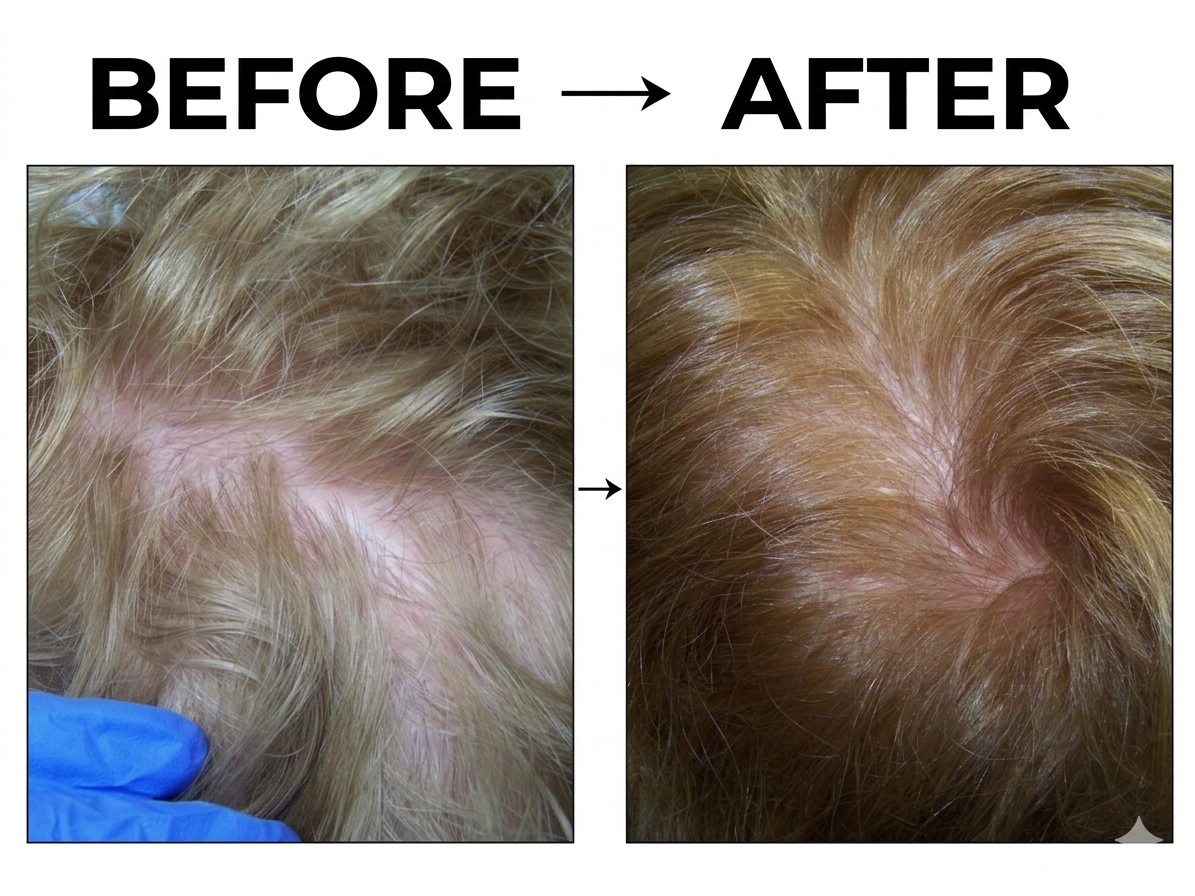
Both case studies were conducted by Kimra Ali — Trichologist and Master in Dermotricology — at Advanced Hair Growth Clinic, Matthews NC. These are clinical records, not testimonials.
- In-Center Care (biweekly): Prep with K1 Tonic to target dry scalp profile. Applied concentrated active blend: 50/50 Turba (Organic Turf) & Collagen mixture combined with 4ml of Fungi Activ. Professional microneedling with Ampoule DT to maximize product delivery and deep cellular absorption
- Topical Home Care: Ampoule DT applied 3× weekly alongside daily applications of Alogenic Tonic directly to thinning zones
- Internal Cellular Support (3-month regimen): Shock Ecology + DePure + Revital — to detoxify the system and stimulate the hair bulb matrix from within
Significant improvement and visible closure of diffuse thinning zones after just 8 weeks. Full 12-week protocol produced dramatic restoration of hair density, structural thickness, and scalp coverage — documented in the before/after image below.
Kimra Ali — Trichologist & Master in Dermotricology
10931 E. Independence Blvd Ste T, Matthews, NC 28105
(980) 938-6100 · advancedhairgrowthclinic.com
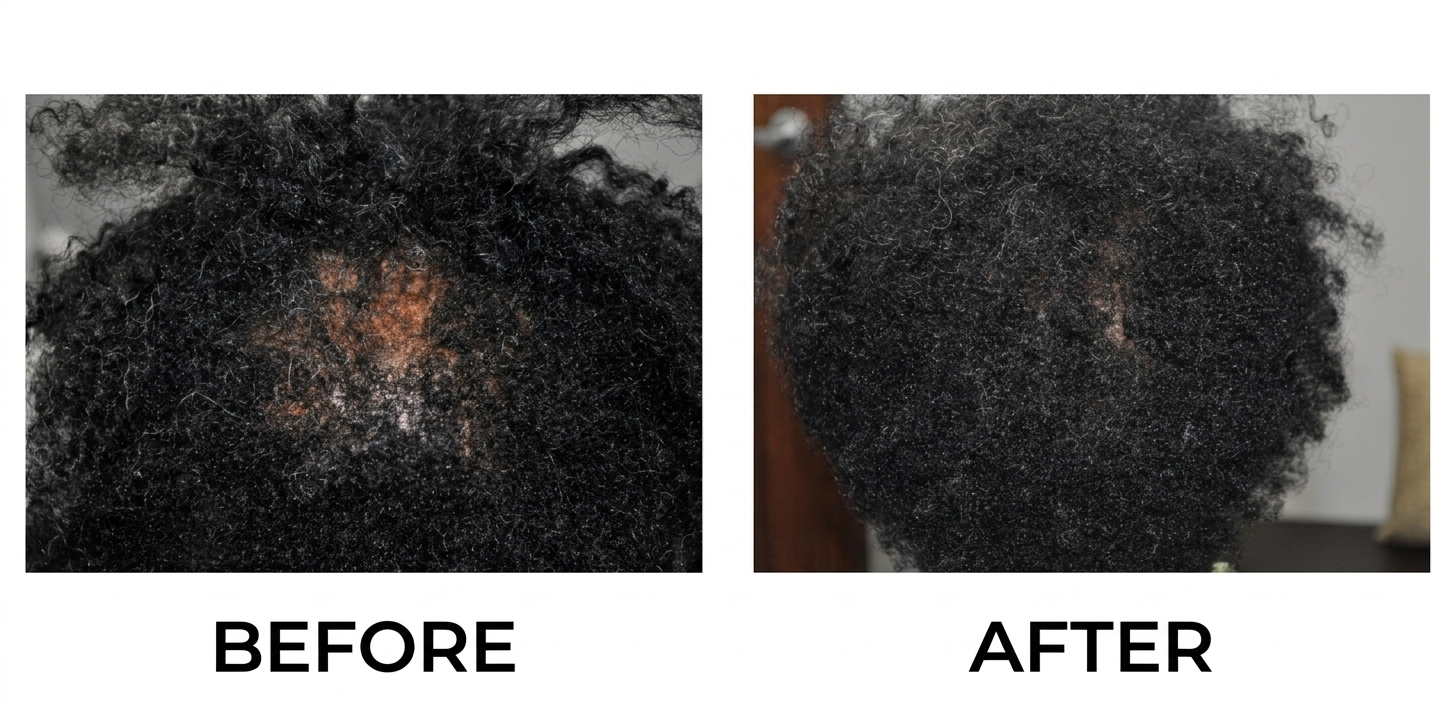
For deeper, localized patches of hair loss or advanced conditions, patience and consistency are key. This case demonstrates the remarkable recovery achievable over a longer timeline — a patient presenting with a prominent, severe crown patch and altered scalp pigmentation, requiring a more intensive and sustained protocol than the 12-week case above.
- In-Center Care (biweekly for 6 months): Prep with K1 Tonic for dry scalp profile. Applied concentrated active blend: 50/50 Turba (Organic Turf) & Collagen + 4ml Fungi Activ. Professional microneedling with Ampoule DT AND Meso therapy using the Kapydermia Professional Plus — devices rotated between visits for maximum cellular stimulation
- Advanced physical modalities: Kapydermia Professional Plus device integrated throughout the 6-month protocol — delivering targeted energy to dormant follicle bulbs alongside active topical compounds for deeper cellular reactivation than topical-only protocols achieve
The exposed area of the scalp achieved near-total coverage — characterized by dense, healthy, tightly coiled hair growth that seamlessly blended with the surrounding hair, while simultaneously restoring a healthy scalp environment. This case reinforces that even when hair loss is deeply concentrated, a methodical Dermotricology protocol can successfully re-engage dormant follicles over time.
Kimra Ali — Trichologist & Master in Dermotricology
10931 E. Independence Blvd Ste T, Matthews, NC 28105
(980) 938-6100 · advancedhairgrowthclinic.com
- Chaikittisilpa, S., et al. (2022). Prevalence of female pattern hair loss in postmenopausal women: A cross-sectional study. Menopause.
- Gupta, A. D., et al. (2025). Menopause and hair loss in women: Exploring the hormonal transition. Maturitas.
- Grymowicz, M. O., et al. (2020). Hormonal effects on hair follicles. International Journal of Molecular Sciences, 21(15), 5342.
- Fabbrocini, G., et al. (2018). Female pattern hair loss: A clinical, pathophysiologic, and therapeutic review. International Journal of Women's Dermatology.
- Trüeb, R. M. (2015). The impact of oxidative stress on hair. International Journal of Cosmetic Science, 37(Suppl. 2), 25–30.
- Cai, C., et al. (2023). An oral French maritime pine bark extract improves hair density in menopausal women: A randomized, placebo-controlled, double-blind intervention study. Health Science Reports.
- Drake, L., et al. (2023). Evaluation of the safety and effectiveness of nutritional supplements for treating hair loss: A systematic review. JAMA Dermatology, 159(1), 79–86.
- Reilly, D. M., et al. (2024). A clinical trial shows improvement in scalp and hair condition following 12-week oral intake of hydrolysed collagen. Dermatology Research and Practice.
Start the clinical protocol —
before more follicles become permanent.
The Kapyderm Hair Loss Home Treatment combines professional-grade topical scalp therapy with targeted internal supplementation — addressing all four drivers of menopausal hair thinning in one dual-action system.