Diffuse Hair Loss Treatment — Plant-Based Home System | Kapyderm USA
35+ Years of Clinical Research  ·  Plant-Based EU-Regulated Formulas  ·  Certified Technicians of Dermotricology in 15+ States
Clinical Dermotricology  ·  Diffuse Hair Loss & Telogen Effluvium

Your Hair Is Falling Out
All Over — Not Just in One Spot.
Here's Why That's Actually Good News.

Diffuse hair loss — also called telogen effluvium — means your follicles are dormant, not destroyed. This is the clinical, plant-based home system that addresses every driver simultaneously, with a certified specialist guiding you the entire way.

Plant-based · EU-regulated · Certified Technicians in 15+ states
Start with a free call

Talk to a Certified Specialist — Free.

A private 20-minute Zoom consultation with a certified Technician of Dermotricology. They'll assess your shedding, answer your questions, and tell you honestly what's realistic — no pressure, no obligation.

Book My Free 20-Min Consultation →
  • Personalized assessment of your hair loss type
  • Honest guidance — including if you should see a doctor
  • No cost, no commitment to buy anything

Ready to begin now? Get the home treatment ($169.46)

You already know this feeling

Hair on the Pillow. Hair in the Drain.
More Than You've Ever Seen Before.

It usually starts 2 to 4 months after something — stress, illness, childbirth, a medication change, rapid weight loss, even a new prescription. By the time the shedding shows up, you've often already moved past whatever triggered it. That's what makes diffuse hair loss so disorienting: the cause feels disconnected from the symptom.

Unlike pattern baldness, this isn't localized to your crown or hairline. It's everywhere at once — which is exactly why it requires a different kind of treatment than a typical hair loss product.

Noticeably more hair in the shower drain or on your brush
Shedding across the entire scalp, not one specific area
Started 2–4 months after stress, illness, or a major life change
Overall hair feels thinner and lighter, not just at the part
Bloodwork came back normal — but you're still shedding
On a GLP-1 medication or recently lost weight quickly
More than 10% of hair releases with a gentle pull test
Recently had COVID or another significant illness

If several of these are true, you're likely experiencing telogen effluvium — and the science is genuinely on your side here.

3–6 mo typical recovery window once the triggering cause is identified and addressed¹
increased incidence of telogen effluvium reported during the COVID-19 pandemic period²
547,993 patient cohort study linking GLP-1 medications (Ozempic, Wegovy) to increased hair loss incidence³
First, the biology

Your Hair Sheds on a Cycle.
Shedding Isn't the Problem — the Ratio Is.

At any moment, most of your follicles are growing and a small share are resting. Losing up to about 100 hairs a day is completely normal — that's just resting hairs letting go as new ones push through. Telogen effluvium happens when a shock flips that ratio: a large share of growing follicles are pushed into the resting phase all at once, and two to three months later they shed together. The follicles aren't gone. They're paused.

~85% of scalp follicles are actively growing (anagen) at any given time in a healthy scalp
~100 hairs a day is normal, everyday shedding — not a cause for alarm on its own
up to 70% of growing hairs can be pushed into the resting phase by a major shock, reversing the normal ratio
Why generic treatments fall short

Diffuse Hair Loss Has Several Drivers.
Most Products Only Address One.

A single supplement, a single shampoo, a single vitamin — none of these address the full biological picture. That's why so many people try one thing after another with limited results. The Kapyderm system was built to treat every driver simultaneously, not sequentially.

Driver 01
Nutritional Deficiency
Iron, Vitamin D, zinc, and protein deficiencies are among the most common — and most overlooked — perpetuating factors in chronic shedding. Hair is non-essential tissue, the first thing your body deprioritizes under stress. Your specialist helps you identify whether testing (ferritin, Vitamin D, zinc) with your doctor is warranted, while the system supports your overall nutritional environment from within.
Driver 02
Follicle Opening Congestion
Oxidized sebum and product buildup block the follicle opening, preventing active ingredients from reaching the root — regardless of how good the topical formula is.
Driver 03
Systemic Inflammation
Chronic low-grade internal inflammation — driven by stress, diet, or liver burden — suffocates follicles from within. Topical treatment alone can't reach this.
Driver 04
Stalled Anagen Re-Entry
Dormant follicles need direct stimulation to restart the growth cycle. Surface-level products often can't penetrate deeply enough to reach the bulb.
What you've probably already tried

Generic Treatments vs.
A Complete Clinical System

ApproachWhat it doesWhat it misses
Biotin alone Addresses biotin deficiency (rare) Iron, Vitamin D, follicle congestion, inflammation, DHT
Minoxidil Increases scalp blood flow Underlying nutritional and inflammatory drivers; reverses when stopped
Generic multivitamins Partial, untargeted nutritional support Scalp environment, follicle congestion, internal detox
Anti-dandruff shampoo Temporary surface cleansing Internal drivers, deep follicle nutrition
Kapyderm Hair Loss Home Treatment All major drivers — simultaneously Built as a complete system, not a single ingredient
Identify your pattern

Diffuse Hair Loss Has
Several Common Triggers

Knowing your specific trigger doesn't change the core protocol — but it helps your specialist fine-tune your custom wash and tonic selection.

Most Common
Stress-Induced Telogen Effluvium
Found in roughly a third of cases. Cortisol elevation pushes follicles prematurely into the resting phase, with shedding peaking 8–12 weeks after the stressful event.
Postpartum
Childbirth-Related Shedding
Pregnancy hormones extend the growth phase, giving many women their thickest hair. After delivery, estrogen drops sharply and those extended-growth hairs shed all at once.
New — 2025/2026
GLP-1 / Ozempic-Associated Shedding
A 2025 cohort study of 547,993 matched patients found significantly increased telogen effluvium incidence among GLP-1 users — driven primarily by rapid caloric restriction and resulting nutritional deficiencies.³
Post-Illness
Post-COVID & Post-Infection Shedding
A documented 3-fold increase in telogen effluvium incidence during the pandemic period, with shedding typically beginning 6–16 weeks after infection.²
Nutritional
Iron, Vitamin D & Zinc Deficiency-Driven
A frequent perpetuating factor even after the original trigger resolves — and often the reason shedding becomes chronic instead of self-limiting.
Hormonal
Thyroid Dysfunction
Both an underactive and an overactive thyroid are well-established triggers of diffuse shedding — and one of the most common reasons it becomes chronic. This is exactly why a thyroid panel belongs in the workup, and why your specialist may point you toward testing with your doctor.
Perimenopause / Menopause
Midlife Hormonal Shift
Chronic telogen effluvium predominantly affects women aged 30–60, especially through perimenopause and menopause, as estrogen declines. Shedding tends to fluctuate — heavier spells interspersed with calmer ones — rather than arriving all at once.
The complete clinical system

The Hair Loss Home Treatment

Kapyderm USA — Customized Dual-Phase Restoration System
Hair Loss Home Treatment
$169.46$225.94 You save $56.48

Every kit includes 2 private Zoom consultations with a certified Master in Dermotricology — and email support that never expires. Not a subscription. Not a cutoff. Included.

1
Hair Loss Wash — Active Phase CleanserClears oxidized sebum and follicle congestion so active treatments can actually penetrate to the root. Used daily during Phase 1.
2
Your Custom Maintenance WashMatched to your specific scalp type — Normalizing, Dry, Oily, Dandruff, or Sensitive. Your specialist confirms the right formula on your first call.
3
Your Custom Targeted TonicBase Tonic for general thinning and recovery, or Alogenic Tonic for established pattern hair loss. Applied daily to stimulate microcirculation.
4
Ampoule DT — 6-PackThe most concentrated step — botanical serums delivered directly into the scalp to reactivate dormant follicle bulbs.
5
Kapydetox (formerly dePure)Green Nettle, dandelion, boldo, fumitory and peppermint — led by nettle (the largest ingredient per dose) — supports internal purification and the inflammatory environment that can suffocate follicles from within. Taken twice daily.
6
ShockCertified-organic spirulina, chlorella and moringa — nutrient-dense greens supplying antioxidants and micronutrients to support the scalp environment from within. Taken nightly.
Talk to a Certified Specialist — Free, 20 min → Not sure this is right for you? Start with a free call — no obligation.
Or get the Hair Loss Home Treatment now → $169.46
What to expect

A Realistic Clinical Timeline

Weeks 1–4
Internal correction — nothing visible yetDeficiencies begin correcting, scalp inflammation starts settling. No visible change is completely normal here. This is the most important phase to stay consistent.
Weeks 6–10
Shedding slowsThe first measurable signal. The drain starts looking different. Scalp sensitivity typically calms as inflammation clears.
Weeks 10–16
New growth appearsShort, fine new hairs emerge at the hairline and crown — reactivated follicles re-entering the active growth phase. This is your second Zoom consultation window.
Months 4–6
Density visibly improvesNew hairs grow long enough to contribute to overall volume. Most people reach their density recovery milestone in this window.
Documented clinical outcomes

Real Clients. Real Results.
Zero Pharmaceuticals.

Clinical records from certified Kapyderm USA Treatment Centers — named practitioners, documented timelines, verified outcomes.

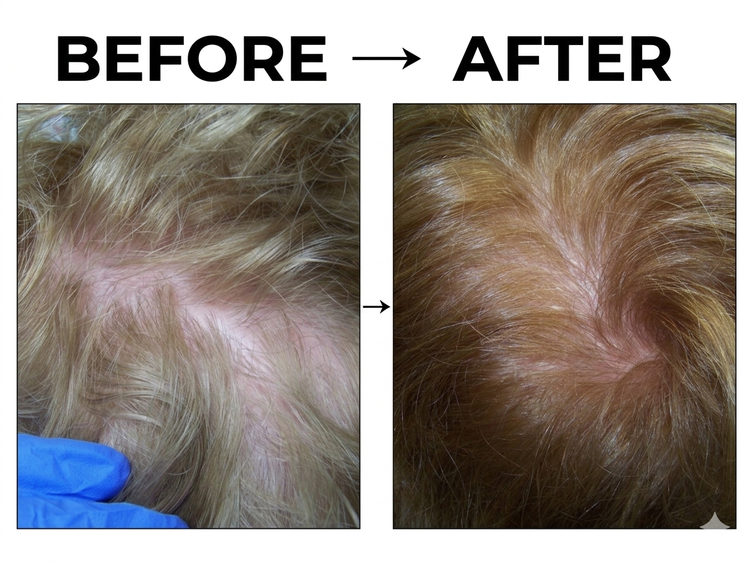
Stress-Induced Telogen Effluvium · 6-Week Protocol
Female, Late 70s — Crown Recovery After Emotional Trauma
Managed by Carole Mendoza, Dermotricology Educator · Mendoza Dermotricology Solutions · Pooler, GA
Before — stress-induced Telogen Effluvium crown hair loss in elderly female patient before treatment
Before: Significant crown loss from emotional stress
After 6-week protocol — full crown density restored
After 6 weeks: Full volume and coverage restored
⟶ 6-week protocol only · Telogen Effluvium is age-independent — follicle biology responded fully at 78, with the same protocol used in this home treatment kit.
Diffuse Thinning · 12-Week Protocol
64-Year-Old Female — Severe Crown Thinning Restored
Managed by Kimra Ali, Master in Dermotricology · Advanced Hair Growth Clinic · Matthews, NC
Before and after — 64-year-old female diffuse crown thinning restored over a 12-week Dermotricology protocol
Before & after 12 weeks: Dramatic density restoration across the crown
⟶ Visible improvement at 8 weeks · Full density at 12 weeks · No pharmaceuticals used
From certified specialists

What Practitioners Are Seeing
in Their Own Clients

"Within 6 weeks, the client exhibited noticeable new growth and improved hair density. Even in a patient in her late 70s, the follicle biology responded completely."
Carole Mendoza — Dermotricology Educator
Mendoza Dermotricology Solutions · Pooler, GA
"After 12 weeks, the patient demonstrated significant improvements in hair density and scalp coverage. The diffuse thinning zones were substantially closed."
Kimra Ali — Master in Dermotricology
Advanced Hair Growth Clinic · Matthews, NC
35+ years of European research
Plant-based formulas
EU-regulated manufacturing
2 specialist consultations included
Email support — never expires
Where the science is settled — and where it isn't

The Evidence, Graded Honestly

We'd rather tell you exactly how strong each claim is than blur it all together. Here's where the research stands.

Well supported
Telogen effluvium is reversible and the follicles are dormant, not destroyed — this is settled dermatology. Most acute cases resolve, with regrowth over 6–12 months once the trigger is addressed.
Well supported
Correcting nutritional status — iron/ferritin, vitamin D, zinc, protein — meaningfully affects regrowth, and GLP-1-associated shedding is driven by rapid weight loss and nutritional gaps, not direct drug toxicity, and is typically reversible.
Supported as a direction
Supporting the scalp environment and microcirculation with topical botanicals, and clearing follicle-opening congestion so actives can reach the root, are mechanism-based and consistent with how the hair cycle works — the rationale is sound, though built on mechanism and tradition more than large trials.
What the literature does not yet show
There is no published head-to-head randomized trial of this specific multi-part system against another treatment. We're honest about that. What we offer is a system built on well-understood biology, real practitioner-documented outcomes, and a certified specialist guiding you — not a claim of proof we don't have.
Make sure it's actually this

When to See a Doctor First

Diffuse, all-over shedding with your hairline intact is the classic picture of telogen effluvium — the situation this system is built for. But some hair loss needs a doctor, not a home treatment. Please get evaluated first if you notice any of these:

Smooth, round or oval bald patches — a sign of alopecia areata, not telogen effluvium
Scalp redness, pain, burning, pus, or shiny scarred areas — possible scarring alopecia, which can become permanent and needs urgent care
A receding or patterned loss at the hairline, temples or crown — more likely pattern hair loss (AGA), which needs a different approach
Loss of eyebrows, lashes or body hair, or shedding with fatigue or weight change — worth a medical and thyroid workup
Shedding that persists beyond 6–12 months without improvement, or if you have diabetes or another systemic condition

Your certified specialist is trained to recognize these signs on your consultation — and if they see something that belongs with a physician, they'll tell you directly. Honest guidance is the whole point.

Frequently Asked Questions

Will my hair actually grow back?
In the vast majority of diffuse hair loss cases, yes. Unlike pattern baldness, telogen effluvium follicles are dormant, not destroyed. Once the internal and topical drivers are addressed simultaneously, follicles re-enter the growth phase. Most people see shedding slow within 6–10 weeks and visible density improvement by months 4–6.
How is this different from just taking a hair vitamin?
Single-ingredient supplements like biotin only help if you have that specific deficiency — and most people don't. This system addresses iron, Vitamin D, zinc, and protein deficiencies simultaneously, alongside follicle-opening congestion, systemic inflammation, and direct follicle reactivation — the full set of drivers behind diffuse hair loss, not just one.
I'm on a GLP-1 medication. Will this work alongside it?
Yes. GLP-1-associated hair loss is primarily driven by rapid caloric restriction and the resulting nutritional deficiencies — not a direct effect of the medication on follicles. This system is designed to correct exactly those deficiencies while you continue your GLP-1 treatment as prescribed by your physician.
What if I don't know which wash or tonic is right for my scalp?
You don't need to know in advance. Your first 20-minute Zoom consultation with a certified Technician of Dermotricology covers exactly this — they'll assess your scalp type and condition and confirm your custom formulation before you even start the protocol.
Is this safe to use with no known underlying cause?
Yes. The system is plant-based and formulated to support general follicle health, nutritional status, and scalp environment regardless of the specific trigger. If your specialist identifies signs during consultation that suggest a condition requiring physician evaluation, they will tell you directly and recommend you see a doctor alongside your treatment.
How long will my shedding last?
Most diffuse shedding is acute telogen effluvium — it follows a single trigger, lasts under six months, and the large majority resolves with regrowth over 6–12 months once the cause is addressed. If shedding continues past six months it's considered chronic, which is more common in women 30–60 and around perimenopause, and usually means a persistent trigger (like thyroid, iron, or an ongoing stressor) still needs to be found. Your specialist helps you work out which pattern you're in.
Could this be hiding pattern hair loss?
Sometimes a shedding episode can unmask genetic pattern thinning (androgenetic alopecia) that was already quietly underway — which is why some people feel their hair "never came back the same." If your loss is patterned (crown, temples, part) rather than evenly diffuse, that points toward pattern hair loss, which needs a different approach. Your specialist will help you tell the difference and point you the right way.

Your Follicles Are Still There.
Let's Wake Them Up.

The Hair Loss Home Treatment addresses every driver of diffuse hair loss simultaneously — with a certified specialist guiding you personally, and support that never ends.

2 Zoom consultations + unlimited email support included · Plant-based · EU-regulated

Clinical References
  1. Hughes EC, Syed HA, Saleh D. Telogen Effluvium. StatPearls, NCBI Bookshelf, 2026. ncbi.nlm.nih.gov/books/NBK430848
  2. Nguyen B, Tosti A. Global Epidemiology of Telogen Effluvium After the COVID-19 Pandemic. JAAD, 2025. PMC11582742
  3. Branyiczky H, et al. Increased Incidence and Risk of Hair Loss with GLP-1 Receptor Agonists: A Real-World Multicentre Cohort Study. EMJ Dermatol, 2025;13(1):52–54.
  4. Ohyama M, et al. Use of 5% Topical Minoxidil for Telogen Effluvium: An Open-Label Single-Arm Clinical Trial. J Dermatol, 2025. PMC12411807
  5. Chien Yin GO, Siong-See JL, Wang ECE. Telogen Effluvium — A Review of the Science and Current Obstacles. J Dermatol Sci, 2021;101(3):156–163.