Inside Nutricosmetics: The Science-Backed European Standard for Cellular Hair and Skin Regeneration
Do Hair Supplements Actually Work?
European Nutricosmetics vs. Nutrafol, Viviscal & Standard Biotin
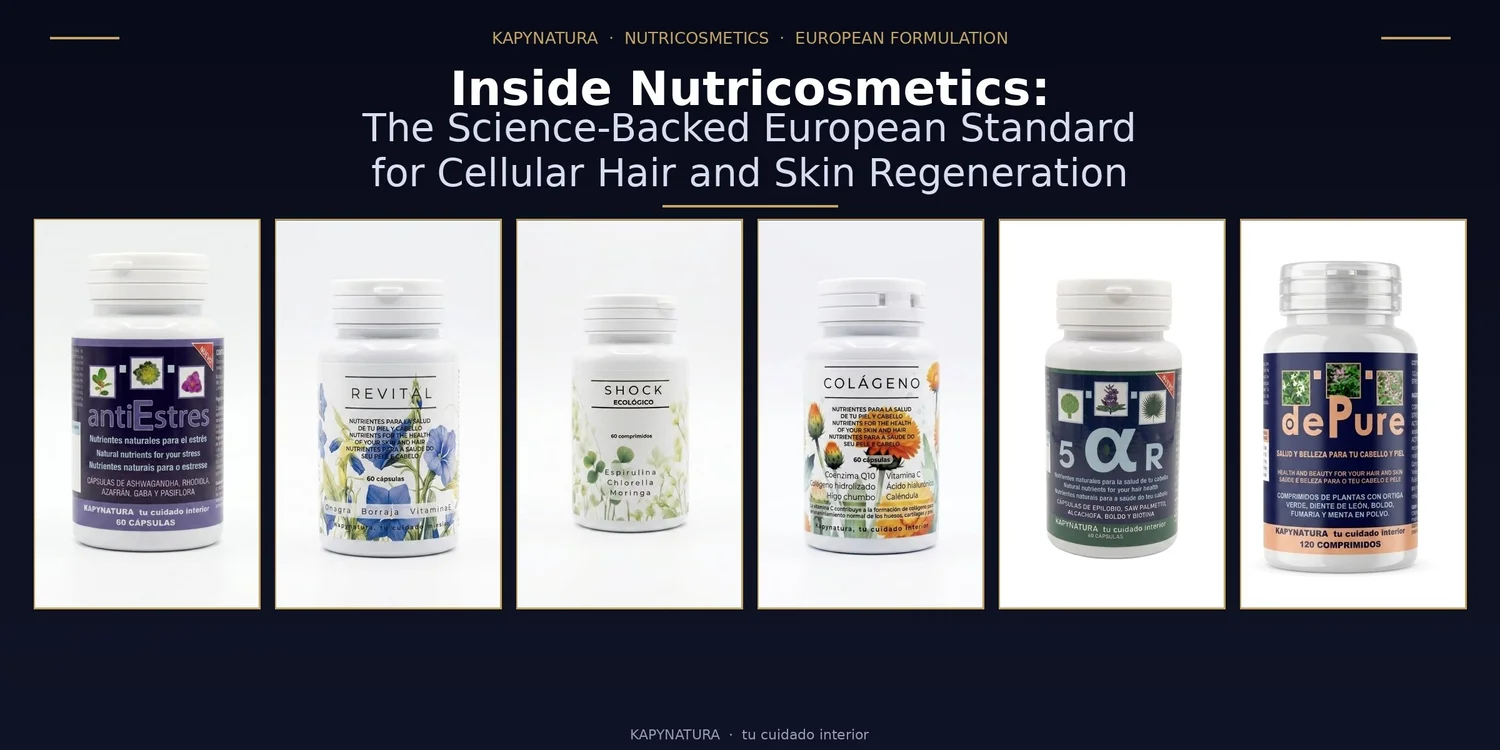
The global nutricosmetics market — oral supplements specifically formulated for hair, skin, and nail health — reached $9.4 billion in 2025 and is projected to exceed $18.6 billion by 2033. That growth is being driven by one simple shift in consumer awareness: topical treatments only work on the surface. Hair health is built from the inside out, and what you put into your body determines what comes out of your follicles.
But the supplement market has a credibility problem. Biotin gummies make the same claims as $88/month premium formulas. Celebrity brands outspend science on marketing. And in the U.S., nobody is checking whether the ingredients in your supplement are actually safe at the doses being sold.
This guide gives you the clinical truth: which ingredients are supported by evidence, what the regulatory gap between U.S. and European supplements actually means for you, and how the Kapynatura line compares to the most well-known names in the category.
1. Do Hair Supplements Actually Work?
The honest answer: it depends on what's in them, at what dose, and what's driving your hair loss. A 2023 systematic review published in JAMA Dermatology evaluated 30 clinical studies on nutritional supplements for hair loss and found that several ingredients show genuine efficacy — but effectiveness is highly dependent on whether the underlying deficiency actually exists in the patient.
What the evidence actually supports
The ingredients with the strongest clinical backing for hair health fall into three categories:
- Marine collagen peptides — provide glycine, proline, and hydroxyproline: the amino acid building blocks that form the hair cortex. A 2024 clinical trial published in Dermatology Research and Practice showed significant improvement in scalp and hair condition after 12 weeks of oral hydrolysed collagen supplementation
- Iron and zinc — iron deficiency is one of the most common and most underdiagnosed drivers of hair loss in women. Zinc regulates follicle cycling and protein synthesis. Both must be in bioavailable forms to be absorbed effectively
- Vitamin D — activates hair follicle receptors and supports the follicle cycling from telogen back into anagen. Deficiency is associated with accelerated Telogen Effluvium and pattern thinning
- Biotin (B7) — supports keratin infrastructure. Effective at correcting biotin deficiency — but most people are not deficient, which is why standalone biotin supplements produce limited results in otherwise healthy individuals
- Plant botanicals (saw palmetto, epilobium) — saw palmetto inhibits 5-alpha reductase, the enzyme that converts testosterone to DHT. DHT is the primary driver of androgenetic alopecia in both men and women
Biotin is the most heavily marketed hair supplement ingredient — but the clinical evidence only supports it for people with an actual biotin deficiency. For people with normal biotin levels, standalone biotin supplements have minimal documented impact on hair growth. The brands selling 10,000mcg biotin gummies are selling you a dose 33,000% above the recommended daily value — with no additional benefit and potential for side effects including interference with lab test results.
2. Why Where Your Supplement Is Made Matters More Than You Think
This is the conversation the U.S. supplement industry does not want you to have. The difference between a supplement manufactured in Europe versus the United States is not a marketing claim — it is a regulatory reality that directly affects what is allowed inside the capsule you swallow.
The U.S. regulatory gap
In the United States, dietary supplements are regulated under DSHEA (Dietary Supplement Health and Education Act of 1994) — a framework that does not require pre-market approval. This means a supplement company can put almost any ingredient on the market without proving it is safe or effective beforehand. The FDA can only take action after a product is already on shelves and causing harm. The FDA restricts approximately 11 to 30 ingredients in supplements — out of thousands used commercially.
The European standard
Products manufactured in the European Union operate under a fundamentally different framework. For topical products, EU Regulation (EC) No 1223/2009 bans or restricts over 1,300 chemical ingredients that are known or suspected carcinogens, endocrine disruptors, or systemic toxins. For oral supplements like the Kapynatura line, EU Directive 2002/46/EC requires:
- Positive list verification — every vitamin, mineral, and botanical must come from a pre-approved, audited safety list. Ingredients not on the list cannot be used
- Substantiated health claims — under EU Regulation (EC) No 1924/2006, every health claim on a European supplement label must be backed by rigorous scientific evidence. You cannot claim a supplement "promotes hair growth" in the EU without peer-reviewed data supporting that specific claim at that specific dose
- EFSA oversight — the European Food Safety Authority functions as an independent scientific gatekeeper, evaluating the safety and efficacy of ingredients before they are approved for use
A supplement manufactured in the U.S. can legally contain ingredients that are banned in European products — including artificial colorants, certain preservatives, and synthetic compounds that have been flagged as endocrine disruptors. When you buy a Kapynatura supplement manufactured in Spain, the EU's regulatory framework has already vetted every ingredient in the formula before it reached the shelf.
3. Kapynatura vs. Nutrafol vs. Viviscal: The Honest Comparison
Nutrafol and Viviscal are the two dominant names in the U.S. hair supplement market. Both have genuine clinical data behind them. Here is how they compare to the Kapynatura line across every factor that matters for long-term results:
| Factor | Nutrafol | Viviscal | Kapynatura (EU) |
|---|---|---|---|
| Manufacturing standard | U.S. — DSHEA regulated | U.S./Ireland — mixed | EU — 1,300+ restricted ingredients |
| Clinical trials | 2 published RCTs in women | 9 published clinical trials | 30+ years European clinical use — EFSA validated ingredients |
| Monthly cost | $79–$89/month | $40–$50/month | Significantly lower — professional wholesale available |
| Biotin dose | 3,000mcg (10,000% DRV) | 200mcg (667% DRV) | 50mcg — clinically appropriate dose |
| Plant-based formula | No — contains marine collagen from fish | No — AminoMar from shark cartilage & oyster | Yes — plant-based actives |
| DHT inhibition | Yes — saw palmetto | No | Yes — Epilobium 400mg (5-Alpha-R formula) |
| Addresses stress-related shedding | Yes — ashwagandha (cortisol) | No | Yes — Shock Ecology formula |
| Ingredient transparency | Partial — Synergen Complex undisclosed doses | Partial — AminoMar undisclosed doses | Full — every ingredient and dose disclosed |
| Suitable for vegans | No (most formulas) | No | Yes |
| Combined topical + internal protocol | No | No | Yes — paired with Kapyderm Dermotricology clinical protocols |
The critical advantage Kapynatura holds over both competitors is the combination of full ingredient transparency, clinically appropriate dosing (not megadosing for marketing impact), plant-based formulas, and the ability to be integrated directly into a Dermotricology clinical protocol for inside-out results.
4. The Six Kapynatura Formulas — What Each Does and Who It's For
Kapynatura is not a one-size-fits-all supplement line. Each formula targets a specific mechanism driving hair loss or skin degradation — allowing for precise, condition-specific internal support alongside a topical clinical protocol.
The #1 selling Kapynatura product. A certified-organic green superfood formula built to support the systemic nutritional environment behind sudden, diffuse shedding — the kind triggered by stress, illness, rapid weight loss, or hormonal shifts. Concentrated micro-algae and moringa deliver a broad nutrient base to the body while the follicle works its way back toward active growth.
Targets the hormonal pathway driving the most common form of hair loss. The 5-alpha reductase enzyme converts testosterone to DHT — and DHT miniaturizes hair follicles over time. Epilobium (willowherb) is a plant-based 5-alpha reductase inhibitor with documented efficacy and none of the sexual side effects associated with pharmaceutical DHT blockers like finasteride.
A comprehensive cellular revitalization formula supporting all phases of the hair growth cycle simultaneously. Where Shock Ecology targets acute shedding and 5-Alpha-R targets hormonal loss, Revital addresses the baseline nutritional foundation for strong, dense, resilient hair — particularly for clients experiencing gradual thinning over years rather than sudden acute loss.
Targets the nervous system driver of hair loss — chronically elevated cortisol pushes follicles into the telogen phase prematurely. Anti-Stress uses a plant-based adaptogenic formula to regulate the stress response at its source, reducing the cortisol-driven hormonal cascade that triggers shedding. Pairs powerfully with Shock Ecology for combined internal and systemic stress support.
The connection between gut health, liver function, and scalp condition is well-established in Dermotricology. Chronic toxin accumulation and compromised digestive function create systemic inflammation that manifests at the follicle level. Depure supports the liver and digestive system — clearing the internal environment that directly impacts scalp health and hair quality. Ideal as a foundational cleanse before starting a hair restoration protocol.
Collagen is the structural scaffolding that surrounds hair follicles in the dermis — as natural collagen production declines approximately 1% per year after age 25, the follicular support structure weakens. This formula replenishes the building blocks supporting follicle anchorage, skin barrier function, and the dermal matrix. Magnesium and Vitamin C are included as cofactors for maximum collagen absorption and synthesis.
Sudden shedding after stress, illness, or weight loss → Shock Ecology
Pattern thinning at hairline, crown, or part → 5-Alpha-R
Gradual thinning, reduced density over time → Revital
Stress and cortisol-driven hair loss → Anti-Stress (pair with Shock Ecology)
Digestive or detox support before starting a protocol → Depure
Skin elasticity, scalp dermal matrix, joint health → Colágeno
Most common combination → Shock Ecology + 5-Alpha-R + Anti-Stress for complete stress + hormonal + acute coverage
Not sure? Book a consultation for a personalized protocol assessment.
5. When Will I See Results? A Month-by-Month Timeline
The most common reason people abandon hair supplements is unrealistic expectations. Hair grows approximately 1cm per month — and the follicle cycle means changes at the root level take 2–3 months to become visible at the surface. Here is what to realistically expect:
The most common mistake with hair supplements: stopping after 4–6 weeks because "nothing is happening." Nothing visible happening at week 4 is not a failure — it is biology. The follicle cycle means internal changes take 8–12 weeks to become visible at the surface. Stopping early resets the process entirely. Commit to a minimum 3-month evaluation window before assessing efficacy.
6. Frequently Asked Questions
- Drake, L., Reyes-Hadsall, S., Martinez, J., et al. (2023). Evaluation of the safety and effectiveness of nutritional supplements for treating hair loss: A systematic review. JAMA Dermatology, 159(1), 79–86.
- Reilly, D. M., et al. (2024). A clinical trial shows improvement in scalp and hair condition following 12-week oral intake of hydrolysed collagen. Dermatology Research and Practice.
- Patel, D. P., et al. (2017). A review of the use of biotin for hair loss. Skin Appendage Disorders, 3(3), 166–169.
- EU Regulation (EC) No 1223/2009 on cosmetic products. Official Journal of the European Union.
- EU Directive 2002/46/EC on the approximation of the laws of member states relating to food supplements. Official Journal of the European Union.
- EU Regulation (EC) No 1924/2006 on nutrition and health claims made on foods. Official Journal of the European Union.
- Metastat Insight. (2025). Nutricosmetics market size and forecast 2025–2033. $9.41 billion base year valuation.
- Beer, C., et al. (2014). A clinical trial to investigate the effect of Cynatine HNS on hair and nail parameters. The Scientific World Journal.
Start the protocol that works
from the inside out.
Six EU-regulated, plant-based Kapynatura formulas — each targeting a specific mechanism driving your hair loss. Find yours and pair it with a Dermotricology clinical protocol for results that go beyond the surface.