The Science of Summer Scalp Care: How to Prevent Sun Damage, Hair Breakage, and Oily Buildup
The 5 Summer Threats to Your Scalp & Hair —
and the Clinical Protocol to Prevent Damage
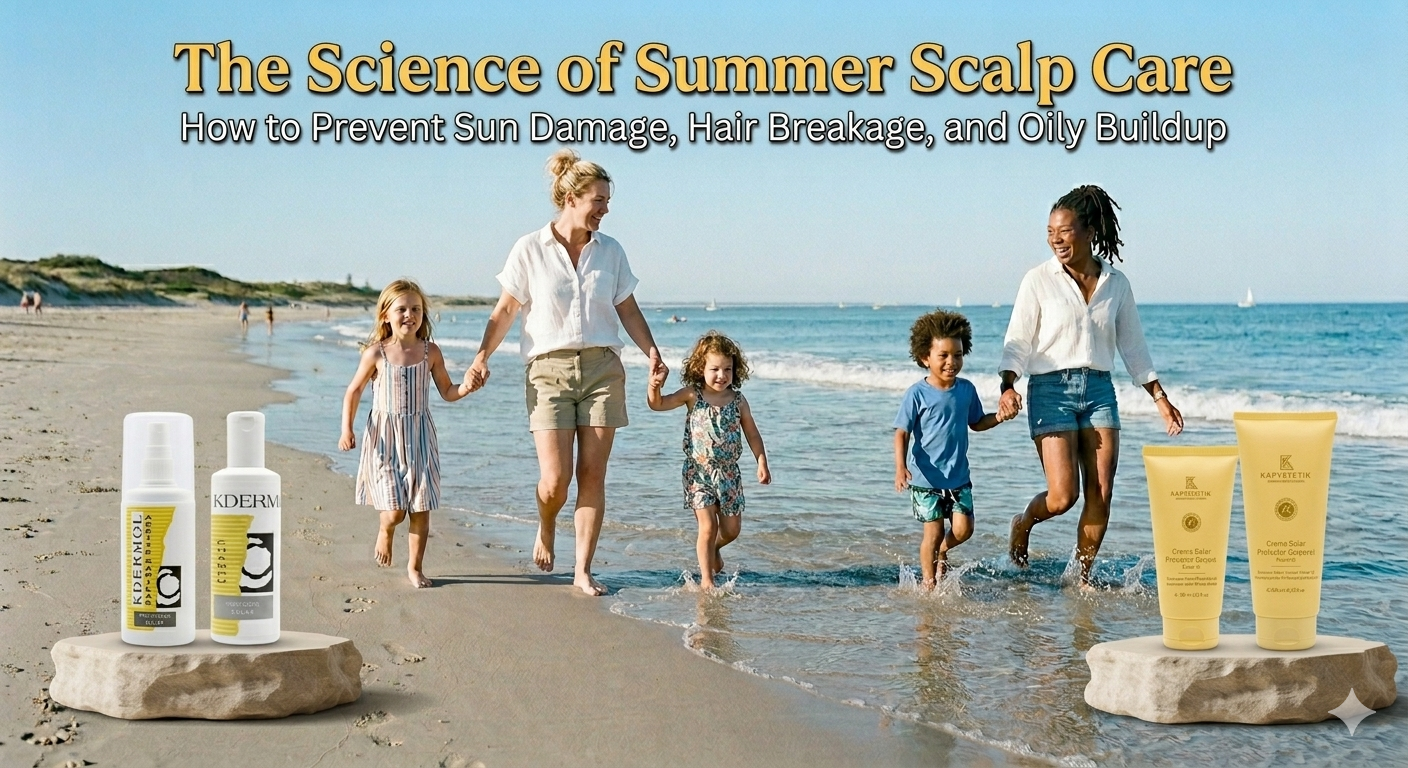
Every summer, the same pattern repeats: more breakage in the shower drain, a scalp that feels greasier by midday, increased itching, and hair that looks dull and lifeless despite your best efforts. Most people blame their shampoo, their water, or simply "the heat." The clinical reality is more specific — and more actionable.
Summer creates a convergence of five distinct environmental threats that act simultaneously on the scalp and hair shaft. Understanding each one individually is how you build a protocol that actually works — rather than reaching for a deep conditioner and hoping for the best.
What makes Dermotricology different from standard hair care is this: we treat the scalp as living tissue and the hair shaft as a structure that reflects the health of that tissue. Every summer threat below operates at the cellular level — and every clinical response we recommend addresses it at that same level.
UV radiation from the sun damages hair and scalp through two distinct mechanisms operating on two different targets — and most sun protection products address only one of them.
What UV does to the hair shaft
UVB radiation attacks the protein structure of the hair shaft directly. Hair is composed primarily of keratin — a fibrous structural protein made of amino acid chains. UVB breaks these chains down at the cysteine-rich regions, weakening the disulfide bonds that give hair its tensile strength and elasticity. The result is hair that feels dry and rough, breaks under minimal tension, and loses its natural shine because the cuticle — the outer protective layer of the shaft — is lifted and cracked rather than lying flat.
UVA radiation penetrates deeper and targets melanin — the pigment molecules inside the hair cortex. UVA oxidizes melanin, causing color fade in natural hair and accelerated brassiness in chemically colored hair. Unlike skin, hair cannot repair UV damage because it has no living cells — each incident of UV damage accumulates permanently in the shaft until the damaged section is cut off.
What UV does to the scalp
The scalp is skin — and it sunburns just like any other exposed skin surface. A sunburned scalp triggers an inflammatory response that increases scalp sensitivity, causes peeling and flaking that mimics dandruff, and — critically — can directly compromise the follicle's environment. Repeated UV exposure to the scalp has been associated with accelerated follicle miniaturization in individuals already predisposed to androgenetic alopecia.
Standard UV hair products create a surface barrier on the hair shaft. The Kapyderm photoprotective approach addresses both targets: a plant-based UV-filter shield for the hair shaft and a cellular antioxidant formula for the scalp skin — neutralizing the free radicals that UV generates in the scalp's lipid layer before they can trigger the inflammatory cascade.
Chlorine is a powerful oxidizing agent — that is precisely why it is effective at disinfecting pool water. The problem is that oxidizing chemistry does not discriminate between bacteria and your scalp's protective lipid layer.
What chlorine does to the scalp
Chlorine breaks down sebum — your scalp's natural oil — compromising the lipid barrier that protects the scalp from water loss, irritants, and inflammation. Most pool water sits at pH 7.2–7.8, significantly more alkaline than your scalp's natural pH of approximately 5.5. This pH mismatch weakens the scalp's acid mantle — the thin protective film that keeps the scalp microbiome in balance. The result: dryness, tightness, flaking, and rebound oiliness as the sebaceous glands overcompensate for the stripped barrier.
What chlorine does to the hair shaft
Chlorine opens the hair cuticle — the protective outer layer of the shaft — dramatically increasing its porosity. With the cuticle open, the vulnerable inner cortex is exposed to friction, oxidation, and the absorption of heavy metals (copper, iron, manganese) that are commonly present in pool water. When chlorine reacts with these metals, they oxidize — producing the greenish tint seen in blonde hair after frequent pool exposure, and causing structural degradation in all hair types regardless of color.
Saturating your hair with fresh water before entering a pool dramatically reduces chlorine absorption — a fully hydrated hair shaft absorbs significantly less chlorinated water than a dry one. Apply a leave-in protective formula immediately after the fresh water rinse to create a barrier before chlorine exposure, not after it.
Salt water is gentler than chlorinated pool water — but it carries its own mechanism of damage that is particularly insidious because the effects are delayed and cumulative.
Ocean water's high salinity creates an osmotic gradient between the water and your hair shaft — pulling moisture out of the hair fiber as the salt draws water toward the higher-concentration solution. As the hair dries after swimming, the water evaporates but the salt crystals remain inside and on the surface of the shaft. These crystals are hygroscopic — they continue drawing moisture out of the hair shaft even after you leave the water, and the physical presence of salt crystals inside the cuticle causes mechanical friction that scratches the cuticle surface from the inside.
Salt water can temporarily benefit an excessively oily scalp by drawing excess sebum out of the follicle opening. However, for anyone with a normal-to-dry scalp or pre-existing scalp condition, salt water significantly worsens dehydration and inflammation. If you have CCCA, traction alopecia, or seborrheic dermatitis, ocean swimming without scalp protection accelerates the inflammatory process.
This is the summer threat nobody is talking about — and the one most directly connected to accelerated hair thinning. Heat triggers sweat gland hyperactivity and stimulates the sebaceous glands to produce more sebum. In a cooler, drier environment, this extra sebum would disperse naturally. In summer heat and humidity, it accumulates on the scalp surface and — critically — oxidizes under UV exposure.
What sebum oxidation does to the follicle
Oxidized sebum is chemically transformed from a protective, lubricating substance into a pro-inflammatory one. It becomes viscous, congests the follicle opening, and creates a microenvironment that is ideal for the overgrowth of Malassezia furfur — the yeast that drives seborrheic dermatitis. This oxidized sebum-yeast combination triggers a low-grade chronic inflammatory response at the base of the follicle that, sustained over months and years, is a documented contributor to follicle miniaturization and accelerated hair loss.
Sweat mixed with styling products, sunscreen, and environmental pollutants creates a toxic film on the scalp surface that blocks follicle openings and maintains a persistently inflammatory environment. Frequent, thorough scalp cleansing in summer is not optional — it is the most important hair loss prevention step of the season. Infrequent washing does not reduce hair loss. It increases it.
The scalp hosts a complex microbiome — a community of microorganisms including bacteria and yeasts that, in a healthy scalp, exist in a carefully balanced ecosystem. Malassezia furfur is a naturally occurring scalp yeast that is benign in small quantities. In summer's warm, humid conditions combined with excess sebum production, Malassezia proliferates rapidly — disrupting the microbiome balance and triggering the inflammatory cascade that manifests as seborrheic dermatitis: the itching, flaking, and redness that so many people experience specifically during summer months.
Why this matters beyond dandruff
Seborrheic dermatitis is not just a cosmetic inconvenience. The research literature has established a significant co-occurrence between chronic seborrheic dermatitis and accelerated hair loss — particularly in those predisposed to androgenetic alopecia or CCCA. The sustained yeast-driven inflammation creates exactly the kind of chronic follicular stress that, over months and years, accelerates follicle miniaturization. Managing summer scalp microbiome health is directly connected to managing long-term hair density.
Standard anti-dandruff shampoos address Malassezia overgrowth with pharmaceutical actives that suppress the yeast but do not restore microbiome balance. The Kapyderm approach uses plant-based botanical tonics (including Fungi Activ) formulated to support a balanced scalp microbiome without disrupting the broader ecosystem — addressing the scalp environment rather than repeatedly suppressing the symptom.
The Complete Summer Scalp Protocol
Addressing all five threats requires a layered approach — prevention before exposure, intervention during the season, and recovery after. Here is the clinical framework organized by frequency:
Summer Damage by Threat — Quick Reference
| Threat | Primary mechanism | Scalp impact | Hair shaft impact | Clinical response |
|---|---|---|---|---|
| UV radiation | Free radical generation, protein chain cleavage | Sunburn, follicle inflammation | Keratin degradation, color fade, cuticle lift | Photoprotective shield + antioxidant scalp formula |
| Chlorine | Oxidation, pH disruption, lipid barrier breakdown | Sebum stripping, acid mantle disruption | Cuticle opening, heavy metal absorption, porosity increase | Pre-swim barrier + post-swim pH-restoring cleanse |
| Salt water | Osmotic dehydration, crystal formation | Dryness, rebound oiliness | Moisture extraction, cuticle friction damage | Fresh water rinse immediately post-swim + moisture restoration |
| Sweat & sebum | Sebum oxidation, follicle congestion | Chronic low-grade inflammation, hair loss risk | Product film trapping, shaft coating | Frequent clinical scalp cleansing + soothing tonic |
| Humidity | Malassezia overgrowth, microbiome dysbiosis | Seborrheic dermatitis, itch, flaking | Frizz, structural moisture fluctuation | Botanical tonic + microbiome-balancing protocol |
Frequently Asked Questions
- Gavazzoni Dias, M. F. R. (2015). Hair cosmetics: An overview. International Journal of Trichology, 7(1), 2–15.
- Trüeb, R. M. (2015). The impact of oxidative stress on hair. International Journal of Cosmetic Science, 37(Suppl. 2), 25–30.
- Okwundu, N., Ogbonna, C., & McMichael, A. J. (2022). Seborrheic dermatitis as a potential trigger of central centrifugal cicatricial alopecia: A review of literature. Skin Appendage Disorders, 9(1), 13–17.
- Draelos, Z. D. (2010). Essentials of hair care often neglected: Hair cleansing. International Journal of Trichology, 2(1), 24–29.
- Robbins, C. R. (2012). Chemical and Physical Behavior of Human Hair (5th ed.). Springer. Chapter 8: Photodegradation of Hair.
Protect your scalp this summer —
before the damage accumulates.
The Kapyderm Summer Scalp Care & Sun Defense Bundle addresses all five summer threats with plant-based clinical formulas. Photoprotection, antioxidant scalp defense, and pH restoration — in one complete clinical routine.