The Kapyderm Ampoule System: N, KN, KD and DT — Which One, When, and Why
The Kapyderm Ampoule System:
N, KN, KD and DT — Which One, When, and Why
Four ampoules. Two families. One ingredient that separates three of them from the fourth. The complete guide to the Kapyderm ampoule system.
Kapyderm ampoules are cosmetic scalp care products, not medicines. This article is educational and is not medical advice. Nothing here diagnoses, treats or cures any condition. If you have sudden, patchy or rapid hair loss, a painful or bleeding scalp, or a scalp condition that is not improving, see a dermatologist — those need medical assessment, not a scalp routine. Individual results vary. Patch test before first use.
If you've ever felt a warming sensation when applying a scalp ampoule and wondered whether something was wrong — it usually isn't. That warmth comes from a specific ingredient, Methyl Nicotinate, and it is an expected cosmetic response. Understanding it is the key to understanding how the Kapyderm ampoules differ from one another.
This guide covers all four Kapyderm Dermotricology ampoules — their full ingredient lists, what each is used for, the published research behind each key active and what that research actually measured, how the formulas compare to two well-known professional products, and when to use each one.
The Kapyderm ampoule system divides into two families: the Purifying Ampoules (N and KN) and the Nutritive Reconstruction Ampoules (KD and DT). The variable across three of the four is Methyl Nicotinate — the ingredient responsible for the warming and reddening response. This article covers every ampoule's full INCI, what it is for, the ingredient research and its limits, an ingredient-level comparison with Kérastase and Nioxin, and when to use each — for home protocol users and certified Technicians of Dermotricology.
- Understanding the Ampoule System — Two Families
- The Key Variable: Methyl Nicotinate
- The Purifying Family: Ampoule N and Ampoule KN
- The Nutritive Family: Ampoule KD and Ampoule DT
- Full Comparison: All Four Ampoules
- Ingredient Comparison: Kérastase and Nioxin
- Ingredient Science: The Key Actives Explained
- Protocol Timeline: What to Expect Week by Week
- Protocol Placement: How the Ampoules Fit
- Frequently Asked Questions
Understanding the Ampoule System — Two Families
The four Kapyderm Dermotricology ampoules are not interchangeable. They are built around two different objectives — purification and nutrition — each with a place in the routine and a scalp presentation it suits. Understanding the system as a whole is the prerequisite for choosing correctly.
Purifying Family: Ampoule N and Ampoule KN — built on a botanical complex of burdock, arnica, rosemary, salicylic acid, sulfur and potassium iodide. Aim: clarify the follicular opening, reduce surface sebum accumulation, and prepare the scalp surface. The single variable between them is Methyl Nicotinate — which KN contains and N does not.
Nutritive Reconstruction Family: Ampoule KD and Ampoule DT — built on Hydrolyzed Keratin, Sodium Hyaluronate, Calcium Pantothenate (B5), Pyridoxine HCl (B6), Cinchona bark extract and the same botanical purifying complex. Aim: condition the hair fiber and support the scalp environment around the follicle. Both contain Methyl Nicotinate. The variable between them is the finishing ingredient: Eucalyptol in KD, Menthol in DT.
Within the Dermotricology routine, ampoule selection is preceded by trichoscopy — the Kapykon Professional Scalp & Skin Analyzer gives a magnified view of the scalp surface before any product is applied. The trichoscopy findings inform which ampoule family is appropriate, and whether the Methyl Nicotinate warming response suits the scalp. This is a cosmetic evaluation, not a medical diagnosis, and a Technician of Dermotricology is not a substitute for a dermatologist.
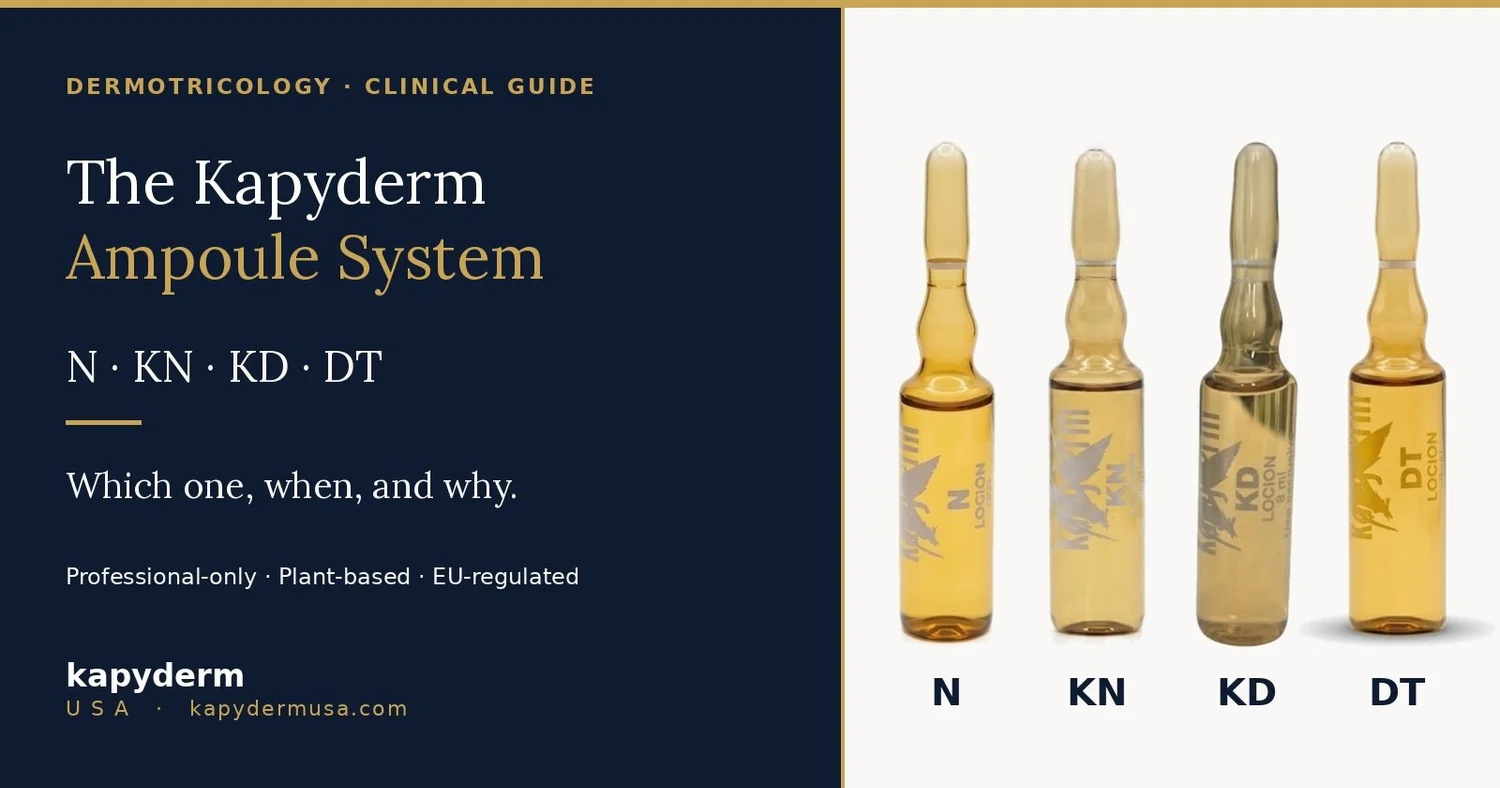
The four Kapyderm Dermotricology ampoules: Ampoule N (purifying, no warming), Ampoule KN (purifying + Methyl Nicotinate), Ampoule KD (nutritive, Eucalyptol finish), Ampoule DT (nutritive, Menthol finish).
The Key Variable: Methyl Nicotinate
Three of the four ampoules contain Methyl Nicotinate (MN). Understanding what it does — and what the research on it actually measured — is fundamental to understanding the system.
Methyl Nicotinate is a nicotinic acid ester. Applied topically, it produces a localized vasodilatory response. A published study using laser speckle contrast imaging quantified the mechanism: inhibiting cyclooxygenase-mediated prostaglandin synthesis with an NSAID reduced the MN-induced perfusion increase by 82% (P < .01), while nerve pathway inhibition reduced it by 32% (P < .01) — pointing to the prostaglandin pathway as the dominant route.[1]
An important scope note on that study: the measurements were taken on skin, not on the scalp. The scalp-level evidence for nicotinates is older and smaller, but it is more directly relevant. A 1987 study in the British Journal of Dermatology examined 10 men with alopecia and found no significant change in scalp blood flow after 3% minoxidil — while 9 of the 10 responded to 0.1% hexyl nicotinate, a closely related nicotinic acid ester.[2] That is a small, decades-old study, and it is the best scalp-specific evidence available for this ingredient class. We would rather say that plainly than imply a larger body of work exists.
What this means practically: when Methyl Nicotinate is in the formula, the warming and reddening you feel is the expected response to the ingredient. What it does not mean is that a measured amount of any other ingredient has reached the follicle. No study has measured how much of the keratin, hyaluronate or panthenol in a Kapyderm ampoule reaches the dermal papilla — that is a reasonable expectation, not a demonstrated result.
Ampoule N is the purifying ampoule without Methyl Nicotinate. This is a deliberate formulation choice, not a limitation. For scalps where clarification is the aim and the warming response would be uncomfortable — sensitive scalps, home use, early-phase routines — N delivers the full purifying botanical complex without it. The choice between N and KN is simply: does this scalp suit the warming response, or not?
The Purifying Family: Ampoule N and Ampoule KN
The purifying ampoules share a botanical complex built around three complementary roles: sebum regulation and antiseptic action (burdock root, sulfur, salicylic acid), soothing and circulatory support (arnica, rosemary), and scalp balancing (potassium iodide, eucalyptol). Their role is to clear the follicular opening of accumulated sebum and surface debris.
Scalps where purification is the aim and the warming response is not wanted. Home use. Sensitive scalps. An introductory ampoule step before progressing to KN in-center.
Mild herbal freshness from Eucalyptol. No warming response. No reddening. Suitable for home use. The Propylene Glycol in Ampoule N (not present in KN) gives the two purifying ampoules a slightly different texture.
The in-center purifying step, for scalps presenting with visible flaking, scaling or excess oil where the warming response is well tolerated. Note: flaking and scaling have several possible medical causes, including seborrheic dermatitis and psoriasis. A cosmetic ampoule does not treat any of them — if a scalp condition has been diagnosed or is not settling, a dermatologist should lead the care.
Methyl Nicotinate warming response — warmth and visible reddening at the application site, typically settling within minutes. Herbal eucalyptol finish. Unlike Ampoule N, KN does not contain Propylene Glycol.
The Nutritive Reconstruction Family: Ampoule KD and Ampoule DT
Where the purifying ampoules address the scalp surface, the nutritive ampoules are formulated around the hair fiber and the scalp environment. KD and DT supply keratin peptides, hyaluronate, panthenol and B vitamins. They are the step after the scalp has been cleansed.
Hair fiber conditioning and scalp nutrition, where hair feels weakened or is breaking, and in diffuse shedding. The most complex formula in the line. The preferred in-center nutritive choice, and the better option of the two for clients with fragrance sensitivities.
Methyl Nicotinate warming response plus Eucalyptol herbal finish. No additional fragrance allergens beyond those in the botanical base — making KD the lower-allergen choice of the two nutritive ampoules.
The same use as KD — hair fiber and scalp nutrition in diffuse shedding. Available in packs of 6 and 20, which makes DT the home-format option of the nutritive family. Some clients prefer the menthol cooling sensation; others prefer KD's herbal finish.
Methyl Nicotinate warming followed by Menthol cooling — the dual sensation that makes DT distinctive. Contains additional preservatives (Sodium Benzoate, Potassium Sorbate, Benzyl Alcohol, Lactic Acid) and two fragrance allergens not present in KD — Linalyl Acetate and Limonene. Patch test recommended.
Full Comparison Table
| Ampoule | Family | Methyl Nicotinate | Keratin + Hyaluronate | Panthenol / B vitamins | Finish | Fragrance allergens | Format |
|---|---|---|---|---|---|---|---|
| Ampoule N | Purifying | No warming | No | No | Eucalyptol (mild) | None listed | 6 or 20 packs |
| Ampoule KN | Purifying | Yes — warming | No | No | Eucalyptol | None listed | 12 × 8ml box |
| Ampoule KD | Nutritive | Yes — warming | Yes — both | Yes — B5 + B6 | Eucalyptol (herbal) | None listed | 12 × 8ml box |
| Ampoule DT | Nutritive | Yes — warming | Yes — both | Yes — B5 + B6 | Menthol (cooling) | Linalyl Acetate + Limonene | 6 or 20 packs |
Ingredient Comparison: Kérastase and Nioxin
If you've been researching professional scalp ampoules, you've encountered Kérastase and Nioxin — the two most recognized names in the category. Both are legitimate, widely used products. The comparison below is based on publicly published ingredient lists as they appeared in July 2026. Cosmetic formulas change without notice, so check the current label before relying on any line below. Nothing here is a claim that one product outperforms another: no head-to-head trial of these three products exists.
Kérastase Spécifique Aminexil Cure Anti-Chute
The Kérastase flagship. Its key ingredient is Diaminopyrimidine Oxide (Aminexil), a molecule developed by L'Oréal. Supporting ingredients include Madecassoside, Rhamnose, Carnosine and Tocopherol (Vitamin E). Methyl Nicotinate is not listed in the published ingredient list, nor is Hydrolyzed Keratin. The formula does list several EU-declared fragrance allergens: Hexyl Cinnamal, Linalool, Hydroxycitronellal, Citronellol and Geraniol.
Nioxin Scalp & Hair Treatment (System 1)
Nioxin is a professional salon system built around scalp care. Notably, Nioxin System 1 does list Methyl Nicotinate — making it one of the few mainstream products using the same ingredient as three of the Kapyderm ampoules. It also lists Niacinamide, Caffeine, Biotin and a botanical blend including green tea, nettle and grapefruit peel extract.
Structurally it is a different kind of product: a pump-bottle leave-on serum rather than a single-use ampoule, with no separate purifying step in the routine. Hydrolyzed Keratin and Sodium Hyaluronate are not listed in the published ingredient list.
| Ingredient / feature | Kérastase Aminexil Ampoule | Nioxin System 1 Treatment | Kapyderm Ampoule KD / DT |
|---|---|---|---|
| Methyl Nicotinate | Not listed (July 2026) | Listed | Listed |
| Hydrolyzed Keratin | Not listed (July 2026) | Not listed (July 2026) | Listed |
| Sodium Hyaluronate | Not listed (July 2026) | Not listed (July 2026) | Listed |
| Panthenol / B5 + B6 | Not listed (July 2026) | B3 listed; B5/B6 not listed | Listed — Panthenol, Calcium Pantothenate, Pyridoxine HCl |
| Separate purifying step in the routine | No — single-product format | No — single leave-on serum | Yes — Ampoule N/KN precede the nutritive step |
| Declared fragrance allergens | Hexyl Cinnamal, Linalool, Hydroxycitronellal, Citronellol, Geraniol | Limonene listed | DT: Linalyl Acetate + Limonene. KD: none listed |
| Regulatory framework | EU-manufactured | US-formulated | Manufactured in Spain under EU Cosmetics Regulation (EC) No 1223/2009 |
| Scalp evaluation before use | Not part of the product | Not part of the product | Kapykon trichoscopy evaluation precedes ampoule selection in-center |
| Head-to-head clinical trial | None published | None published | None published |
Kérastase makes a well-formulated, professionally finished product. Nioxin makes a well-distributed system used in tens of thousands of salons. Neither is a bad product, and neither has been tested against Kapyderm. What the table shows is a difference in formulation approach — the Kapyderm nutritive ampoules combine a keratin and hyaluronate base with a vasodilatory ingredient and sit inside a two-step routine with a separate purifying phase. Whether that structure produces better outcomes is not something any published trial has measured.
Protocol Timeline: What to Expect Week by Week
One of the most common questions in scalp ampoule research is simply: how long does it take? Here is the routine structure and what people commonly report at each stage. These are the phases of the routine, not predicted outcomes — no clinical trial has measured what the Kapyderm ampoule system produces over 12 weeks, and individual responses differ.
| Phase | Timeline | What the routine is doing | What people commonly report |
|---|---|---|---|
| Attack Phase | Weeks 1–3 Intensive — 2–3× weekly |
The purifying ampoule (N or KN) is clearing surface sebum and debris from the follicular opening. Salicylic acid is lifting scale and improving access to the scalp surface. Where KN is used, the Methyl Nicotinate warming response occurs at each application. | Less greasiness and surface irritation. The warming response at each application where KN is used. Some people notice increased shedding in the first weeks — if shedding is heavy, sudden or patchy, stop and see a dermatologist rather than continuing. |
| Normalizing Phase | Weeks 4–8 Transitional — 1–2× weekly |
The nutritive ampoule (KD or DT) is applied to a cleansed scalp, delivering keratin peptides to the fiber along with hyaluronate, panthenol and B vitamins. | Scalp feels cleaner and less reactive between washes. Hair often feels stronger and less prone to breakage — the keratin conditioning effect on the fiber, which is a cosmetic change to existing hair rather than new growth. |
| Consolidation Phase | Weeks 9–12 Maintenance — 1× weekly |
The routine steps down in frequency. The scalp environment has had 8–10 weeks of consistent cleansing and conditioning. | Scalp condition generally stable and easier to manage. Most people transition to a weekly home routine (Ampoule N or DT) at this stage rather than continuing at attack intensity. |
| Maintenance | Week 12+ Ongoing — 1× weekly or fortnightly |
The aim shifts from intensive care to upkeep — keeping the scalp cleansed and comfortable as an ongoing routine. | Scalp remains balanced between washes. A Technician of Dermotricology can use Kapykon trichoscopy to review and adjust the routine if a new shedding trigger appears — and to flag anything that should be seen by a dermatologist. |
Individual experience varies with the starting condition of the scalp and hair, the underlying cause of any shedding, and how consistently the routine is followed. The table above describes the structure of the routine, not a promised result. Hair loss has many causes — hormonal, nutritional, medication-related, autoimmune — and most of them need a medical assessment. A cosmetic scalp routine can sit alongside that assessment; it cannot replace it.
Ingredient Science: The Key Actives Explained
The four ampoules draw on two active complexes. Below is what the published research on each key ingredient found — and, just as importantly, what it was measuring. Every study cited here tested an isolated ingredient, in cell culture, on hair fibers, on skin or in an injectable formulation. None of them tested a Kapyderm ampoule.
The Purifying Complex — Shared by All Four Ampoules
Arctium Majus Root (Burdock Root)
Rich in tannins, polyphenols, mucilage and fructo-oligosaccharides. Burdock root has documented soothing, sebum-regulating and antibacterial properties in the botanical literature.[12] It is present across the oily scalp range in the Dermotricology line (Oily Hair Wash, KS115, Ampoule N and KN), which is why it functions as the sebum-regulation anchor botanical in the system. The limit: that evidence is for the plant extract in general pharmacological study, not for burdock as formulated in these ampoules at these concentrations.
Arnica Montana Flower Extract
Present in all four ampoules. The primary active constituents of Arnica montana are sesquiterpene lactones, principally helenalin. Two foundational studies established the mechanism: a 1997 paper in Biological Chemistry showed helenalin selectively inhibits activation of the transcription factor NF-κB, and a 1998 follow-up in the Journal of Biological Chemistry identified how — helenalin alkylates the p65 subunit of NF-κB directly.[8]
The limit: these are laboratory studies of an isolated compound and its effect on a signaling pathway. NF-κB is involved in inflammation broadly, but no study has shown that arnica extract in a leave-on scalp ampoule alters inflammation in the human scalp, or affects hair growth.
Rosmarinus Officinalis (Rosemary Leaf Extract)
Rosemary has the strongest human trial evidence of any botanical in these formulas. A 2015 randomized comparative trial in Skinmed enrolled 100 patients with androgenetic alopecia and found rosemary oil produced comparable hair count improvement to minoxidil 2% at 6 months, with less scalp itching in the rosemary group.[9]
A 2025 double-blind placebo-controlled trial published in Cureus enrolled 90 participants over 90 days with phototrichogram measurement, comparing a rosemary-and-lavender blend against a coconut oil control, and reported improvements in growth rate, thickness and density.[10]
Two limits worth naming. Both trials tested rosemary oil as the intervention, at its own concentration — not rosemary leaf extract as one ingredient among eighteen in an ampoule. And the 2025 trial tested a rosemary-lavender combination, so its results cannot be attributed to rosemary alone.
Salicylic Acid + Sulfur + Potassium Iodide
Salicylic acid is a beta-hydroxy acid with well-established keratolytic action — it lifts and softens scale and oxidized sebum debris at the follicular opening. A January 2025 prospective cohort study in the Journal of Cosmetic Dermatology followed 20 patients with moderate-to-severe scalp seborrheic dermatitis treated with topical salicylic acid and reported 80% overall improvement at 4 weeks, with dandruff scores falling from 2.45 to 1.10.[11]
The limit: 20 patients, no control group and no blinding — an uncontrolled cohort study is the weakest form of clinical evidence, and it studied salicylic acid, not a Kapyderm ampoule. Sulfur provides complementary sebum balance and antimicrobial action; Potassium Iodide contributes additional purifying activity.
The Nutritive Reconstruction Complex — KD and DT Only
Hydrolyzed Keratin
Keratin is the primary structural protein of hair. Hydrolyzed keratin is broken into smaller peptides, and molecular weight determines what those peptides do. A 2021 study in the International Journal of Cosmetic Science found that low molecular weight keratin (around 221 Da) penetrates the hair cortex, while medium-to-high molecular weight fractions (around 75,440 Da) form a film on the fiber surface instead.[3] Both effects are useful; they are simply different.
A 2025 study in Molecules confirmed via SEM and fluorescent penetration that hydrolyzed keratin deposits on the cuticle to form a protective film while partially penetrating the cortex, and found tensile strength maintained in treated hair after UV exposure while untreated hair lost 14.32%.[4]
The limit: both studies tested keratin solutions on hair fibers in a laboratory. This is fiber conditioning — an effect on hair that already exists. It is not an effect on the follicle or on growth.
Sodium Hyaluronate
The sodium salt of hyaluronic acid — the water-binding glycosaminoglycan present in the dermal matrix around the follicle. A 2021 study in BioMed Research International found non-crosslinked hyaluronic acid restored viability in human follicle dermal papilla cells against UVB-induced cytotoxicity and increased VEGF secretion.[5] A 2026 study in the International Journal of Biological Macromolecules found medium-molecular-weight hyaluronic acid the most bioactive fraction for follicle regeneration, acting via the CD44/AKT axis.[6]
Two significant limits. The 2021 study tested an injectable mesotherapy formulation, and its authors explicitly called for clinical investigation. The 2026 study was done in cell culture and in mice. Neither tested topical cosmetic application to a human scalp.
Panthenol + Calcium Pantothenate (Vitamin B5)
Dexpanthenol is the precursor of Vitamin B5. A 2021 study in Current Issues in Molecular Biology reported the following in cultured human dermal papilla cells and outer root sheath cells:[7]
• Increased the proliferation marker Ki67; reduced apoptosis markers Caspase3/9 and senescence markers p21/p16
• Alkaline phosphatase activity increased by 40%; β-catenin and versican activated
• TGF-β1 expression reduced by 30%
• VEGF expression increased by 70%, with VEGF and VEGFR upregulated in outer root sheath cells
The limit, and it matters: every one of those figures comes from cells in a dish. Biomarkers that move in culture frequently do not translate to hair on a head, and no trial has tested dexpanthenol topically for hair growth in people.
Pyridoxine HCl (Vitamin B6)
Pyridoxine is a required cofactor for amino acid metabolism — the process producing the cysteine, methionine and glycine that build keratin. This is established nutritional biochemistry. The limit: it describes B6's role in the body when consumed. Whether topically applied B6 in a leave-on scalp ampoule contributes meaningfully to keratin synthesis in the follicle has not been demonstrated.
Cinchona Succirubra + Tussilago Farfara + Achillea Millefolium
Cinchona Succirubra (quinine bark) has a long documented tradition in hair tonic formulation. Tussilago Farfara (coltsfoot) contributes soothing and conditioning action. Achillea Millefolium (yarrow) brings astringent and scalp-balancing properties. These are traditional-use botanicals — included for their long history in this category rather than on the strength of clinical trial data, and we would rather say so than dress tradition up as science.
Methyl Nicotinate — In Three of Four Ampoules
Present in KN, KD and DT. As covered above, MN is a nicotinic acid ester that produces local vasodilation, quantified on skin by laser speckle contrast imaging[1] and demonstrated at the scalp in a small 1987 study of a related nicotinate.[2]
One point of transparency: Methyl Nicotinate is a synthetic ester, not a botanical. The three ampoules containing it — KN, KD and DT — are therefore not plant-based formulas. Ampoule N contains no Methyl Nicotinate. We would rather state that clearly than describe the whole range as plant-based when three of four products are not.
Protocol Placement: How the Ampoules Fit the Full Dermotricology System
In the Kapyderm Dermotricology routine, the ampoule step follows the cleansing base — the Hair Loss Wash or the appropriate cleansing base for the scalp type. The cleansing base resets scalp pH (target: 5.0–5.5) and removes surface accumulation. For attack-phase routines, the Organic Turba peat mask may precede the ampoule step.
Step 1: Cleansing Base (Hair Loss, Normalising, Dandruff, Oily or Dry) → pH reset, surface removal
Step 2 (attack phase): Organic Turba Mask — 20 minutes, emulsified and rinsed
Step 3: Ampoule (N, KN, KD or DT — selected after trichoscopy) → applied to clean, dry scalp. Leave on. Do not rinse.
Step 4: Tonic (Base, Alogenic, K1, K2, KS115, Fungi Activ or Seboregulator — by scalp type) → secondary leave-on layer
Step 5 (if indicated): Balsamic Collagen Emulsion or Special K Cream → conditioning or moisturizing finish
The ampoule selection logic at Step 3 follows this decision tree:
- Visible flaking, scaling or excess oil, warming response well tolerated (in-center): Ampoule KN — purifying with Methyl Nicotinate
- Purification wanted, no warming response appropriate (home use, sensitive scalp): Ampoule N — purifying complex without Methyl Nicotinate
- Hair fiber conditioning and scalp nutrition, fragrance-sensitive client (in-center): Ampoule KD — Eucalyptol finish, no Linalyl Acetate or Limonene
- Hair fiber conditioning and scalp nutrition, home routine or preference for cooling (home): Ampoule DT — same nutritive base, Menthol finish, home pack sizes
Full routine guidance — attack, normalizing and maintenance phase sequencing, layering with tonics, combined purifying and nutritive routines, and Kapykon trichoscopy image interpretation — is available by getting in touch.
Ampoule selection should be preceded by Kapykon trichoscopy. The findings inform which ampoule suits the scalp and at what frequency. Trichoscopy is a cosmetic evaluation of the scalp surface and hair caliber — it is not a diagnostic procedure, and findings that suggest a medical condition should be referred to a dermatologist rather than managed with a scalp routine.
Interested in offering Dermotricology in your practice? Contact us to discuss training and certification.
Frequently Asked Questions
- Elawa S, et al. (2020). Skin blood flow response to topically applied methyl nicotinate: Possible mechanisms. Skin Research and Technology, 26(3), 343–348. doi:10.1111/srt.12807. PMID 31777124 — NSAID inhibition reduced MN-induced perfusion increase by 82% (P < .01); nerve pathway inhibition by 32%. Measured on skin, not scalp.
- Bunker CB, Dowd PM. (1987). Alterations in scalp blood flow after the epicutaneous application of 3% minoxidil and 0.1% hexyl nicotinate in alopecia. British Journal of Dermatology, 117(5), 668–669. PMID 3689690 — 10 men; no significant scalp blood flow change with 3% minoxidil; 9 of 10 responded to 0.1% hexyl nicotinate.
- Malinauskyte E, et al. (2021). Penetration of different molecular weight hydrolysed keratins into hair fibres and their effects on the physical properties of textured hair. International Journal of Cosmetic Science, 43(1), 26–37 — low MW (~221 Da) penetrates the cortex; medium-to-high MW (~75,440 Da) forms a surface film.
- Fan J, et al. (2025). Performance and mechanism of hydrolyzed keratin for hair photoaging prevention. Molecules, 30(5), 1182. doi:10.3390/molecules30051182 — tensile strength maintained after UV exposure vs 14.32% loss in untreated hair. Laboratory study on hair fibers.
- Zerbinati N, et al. (2021). In vitro hair growth promoting effect of a noncrosslinked hyaluronic acid in human dermal papilla cells. BioMed Research International, 2021:5598110 — increased VEGF secretion. Tested an injectable mesotherapy formulation; the authors call for clinical investigation.
- Liu J, et al. (2026). Medium-molecular weight hyaluronic acid orchestrates hair follicle regeneration via CD44/AKT-driven endogenous ROS activation of β-catenin. International Journal of Biological Macromolecules — cell culture and mouse study, not topical cosmetic use.
- Shin JY, Kim J, Choi YH, Kang NG, Lee S. (2021). Dexpanthenol promotes cell growth by preventing cell senescence and apoptosis in cultured human hair follicle cells. Current Issues in Molecular Biology, 43(3), 1361–1373. doi:10.3390/cimb43030097. PMID 34698060; PMC8929036 — ALP +40%, VEGF +70%, TGF-β1 −30%, Ki67 increased. All measured in cultured cells.
- Lyss G, Schmidt TJ, Merfort I, Pahl HL. (1997). Helenalin, an anti-inflammatory sesquiterpene lactone from Arnica, selectively inhibits transcription factor NF-κB. Biological Chemistry, 378(9), 951–961. doi:10.1515/bchm.1997.378.9.951. Follow-up: Lyss G, et al. (1998). Journal of Biological Chemistry, 273(50), 33508–33516. PMID 9837931 — helenalin alkylates the p65 subunit of NF-κB.
- Panahi Y, et al. (2015). Rosemary oil vs minoxidil 2% for the treatment of androgenetic alopecia: a randomized comparative trial. Skinmed — 100 patients; comparable hair count increase at 6 months; less scalp itching in the rosemary group.
- Patel, et al. (2025). Randomized double-blind placebo-controlled trial of a rosemary and lavender oil blend for hair growth. Cureus, 17(6), e85906. doi:10.7759/cureus.85906. Registered CTRI/2024/07/071115 — 90 participants, 90 days, phototrichogram measurement, coconut oil control. Tested a rosemary-lavender blend, not rosemary alone.
- Ge Y, et al. (2025). A cohort clinical study on the efficacy of topical salicylic acid in improving symptoms of moderate to severe seborrheic dermatitis of the scalp. Journal of Cosmetic Dermatology. PMC11705510 — 20 patients, uncontrolled, unblinded; 80% overall improvement at 4 weeks.
- Springer Nature. (2024). Harnessing the power of Arctium lappa root: A review of its pharmacological properties and therapeutic applications. Natural Products and Bioprospecting. doi:10.1007/s13659-024-00466-8 — review of the botanical literature on burdock root.
12 sources. Every study cited tested an isolated ingredient — in cell culture, on hair fibers, on skin, in mice, or in an injectable formulation. No controlled trial of the Kapyderm ampoule system exists, and no head-to-head trial against any competitor product exists. Ingredient research indicates why a formula is built the way it is; it does not demonstrate what the finished product does. Last reviewed August 2026.
Experience the ampoule system with a certified Dermotricologist.
Ampoule selection works best after a scalp evaluation. Find a certified Technician of Dermotricology near you, or explore the range.