Winter Scalp Eczema Is Usually Seborrheic Dermatitis: How to Tell Your Flakes Apart
Winter Scalp Eczema Is Usually Seborrheic Dermatitis:
How to Tell Your Flakes Apart.
Every year the calls start when the heat comes on. Flakes on a dark sweater, an itchy hairline, a scalp that feels tight one day and greasy the next. Most people call it dry scalp or scalp eczema and reach for an oil. Most of the time what I see is seborrheic dermatitis, a condition linked to a yeast that lives on everyone's skin, and it tends to flare in the cold months. Treating it like dry skin can mean treating the wrong thing. This is how the common causes of winter flakes differ, what the over-the-counter shampoos are allowed to treat, and when flakes mean it is time to see a doctor.
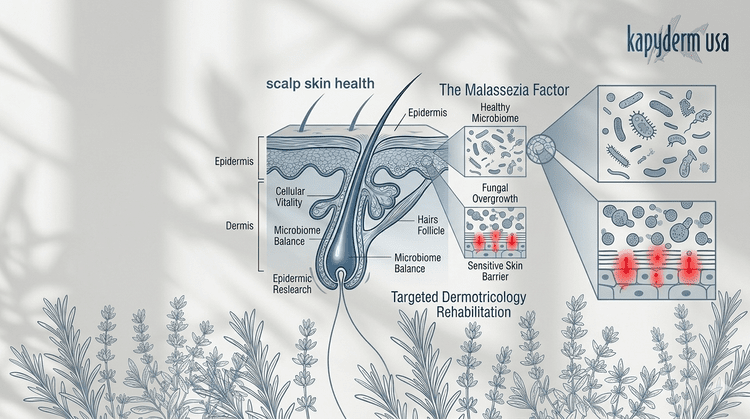
“Scalp eczema” is an umbrella term. The National Eczema Association calls seborrheic dermatitis “the most common form of scalp eczema.”[1] It shows up as greasy, yellowish flakes with redness, and it is linked to a reaction to Malassezia, a yeast that lives on everyone's skin.[1][2] The American Academy of Dermatology says flare-ups are often seasonal, with most in winter and early spring.[3] At one dermatology clinic in Istanbul, 35.3% of seborrheic dermatitis diagnoses over two years came in winter and 13.5% in summer.[4] Truly dry scalp, scalp psoriasis, allergic reactions to hair products and fungal scalp infections can look similar but need different care. Mild seborrheic dermatitis often responds to an over-the-counter dandruff shampoo left on the scalp for the time on its label.[5][6] See a doctor if it does not improve, if it oozes, crusts or hurts, if hair falls out in patches, or if it is a child's scalp.[7][8][9][5]
- What “scalp eczema” actually means
- Why seborrheic dermatitis flares in winter
- How to tell your flakes apart
- Dry scalp or seborrheic dermatitis? Why it matters
- How to treat scalp eczema: what the over-the-counter shampoos can do
- How to use a dandruff shampoo so it works
- Curly, coily and textured hair
- Can seborrheic dermatitis cause hair loss?
- When to see a doctor
- What the top search results leave out
- What I tell clients every winter
- The evidence behind this article, graded
- Frequently asked questions
What “Scalp Eczema” Actually Means
“Scalp eczema” is not one condition. The National Eczema Association describes it as an inflammatory condition with several causes, “including seborrheic dermatitis (dandruff), contact dermatitis and atopic dermatitis.”[1] Of those, seborrheic dermatitis is the most common form on the scalp.[1] So when someone tells me they have scalp eczema in January, my first question is which kind, because the answer changes what helps.
Seborrheic dermatitis appears where the skin makes the most oil, and the AAD says the rash usually develops on the scalp.[2][3] The NEA describes greasy, yellowish flakes and redness.[1] A clinical reference describes the patches as having a fine white scale with a yellowish, greasy crust and edges that are poorly defined.[10] On darker skin tones, the AAD notes it can also leave dark spots and patches.[3]
Dandruff sits on the same spectrum. The AAD says dandruff may be considered the mildest form of seborrheic dermatitis, and that the difference is inflammation: seborrheic dermatitis causes swelling and discolored skin, and dandruff does not.[3] Dandruff is very common. A clinical reference puts it at probably close to half of people worldwide.[10]
How common seborrheic dermatitis itself is depends on who counted. Estimates for adults run from 1 to 3% in one review, to around 5% worldwide in another reference, to 3 to 10 in 100 people on the NEA's page.[11][10][1] In a Dutch study where doctors examined the full skin of 5,498 middle-aged and older adults, 14.3% had it.[12] The AAD says men are more likely to develop it than women, and that in the United States, Black people are the most likely to develop it.[3]
What it is not: it is not contagious, not caused by unclean skin and not an allergy.[2][3] The yeast involved, Malassezia, lives on the skin of most healthy adults.[11] The AAD explains that people with seborrheic dermatitis may have developed a reaction to that yeast, which is why only some people get it.[2]
Why Seborrheic Dermatitis Flares in Winter
The seasonal pattern is real, and it is one of the better-documented things about this condition.
The AAD says flare-ups are often seasonal, with most occurring in winter and early spring, and that seborrheic dermatitis may disappear during warm, humid weather.[3] On its self-care page it is direct about the cause: “Flare-ups are common when the weather turns cold and dry. The dryness often causes seborrheic dermatitis to flare.”[13] It also lists hot showers and baths during cold, dry weather as a trigger, because hot water can dry the skin and scalp.[13]
The clearest numbers come from Istanbul. Researchers reviewed the records of 90,805 adult patients seen at a hospital dermatology clinic from June 2018 to May 2020. 5,316 patients were diagnosed with seborrheic dermatitis. Of those diagnoses, 35.3% came in winter, 32.9% in autumn, 18.3% in spring and 13.5% in summer. December had the most diagnoses and June the fewest. Colder months had a higher share of clinic patients diagnosed with it.[4] In the Netherlands, the Rotterdam Study found the same direction: people examined in summer were less likely to have it than people examined in winter.[12]
Why the cold matters is less settled. Sunlight may help: MedlinePlus notes some people improve in summer, especially after time outdoors, and the Istanbul authors cite research that sunlight suppresses Malassezia.[7][4] Cold, dry air and hot showers can dry and irritate the skin barrier.[13] Winter also brings hats, heavier styling products and, for many people, washing less often. Those are my clinical observations, not measured causes.
The Istanbul study counts clinic diagnoses, not how many people in the city had the condition. It was retrospective, from one hospital, with mostly white patients, and the authors say no definite conclusions about cause can be drawn.[4] Its humidity findings are inconsistent, so I have not used them. The Rotterdam figures come from a summary, and one author works for a company that makes shampoo.[12] And winter is not the only trigger: the NEA lists hot or humid climates and heavy sweating among the triggers for scalp eczema.[1] Most people flare in the cold months. Not everyone does.
How to Tell Your Flakes Apart
This is the part most pages skip. These conditions can look alike, and a person can have more than one. The AAD notes it is possible to have both seborrheic dermatitis and psoriasis, which is often called sebopsoriasis.[5] Use this as a guide to what to ask about, not as a diagnosis.
| What it may be | What the flakes look like | Other clues | What usually helps |
|---|---|---|---|
| Dry scalp | Itchy flaking; the scalp feels dry[14] | The skin has lost water; cold, low-humidity weather and harsh products can cause it[14] | A gentle, non-medicated shampoo[14] |
| Dandruff | Flaking without redness or swelling | Considered the mildest form of seborrheic dermatitis[3] | An over-the-counter dandruff shampoo[14] |
| Seborrheic dermatitis | Greasy, yellowish flakes on red or discolored skin; edges are not sharp[1][10] | Worse in winter; comes and goes; may leave dark patches on darker skin[3] | Dandruff shampoo for mild to moderate cases; a dermatologist if not[5] |
| Scalp psoriasis | A silvery sheen and dry scale; thicker, sharply edged plaques[15][11] | Skin may crack and bleed; can appear behind the ear; nails may change[15][10] | Coal tar or salicylic acid over the counter; a dermatologist for more[16] |
| Contact dermatitis | Flaking, swelling and itching where a product touched | Started after a new hair dye, shampoo, fragrance, bleach or styling product[1] | Stop the product; patch testing can find the allergen[1] |
| Atopic dermatitis | Dry, itchy, easily irritated skin | The most common type of eczema overall, from an overactive immune response that weakens the skin barrier[1] | A dermatologist's plan for eczema |
| Fungal scalp infection (tinea capitis) | Scaly bald patches, sometimes with black dots of broken hair[8] | Mostly children; can spread from person to person[9][14] | A doctor and prescription medicine taken by mouth; shampoo alone will not cure it[9] |
Two cautions. Itch does not reliably tell psoriasis from seborrheic dermatitis: one clinical reference calls scalp psoriasis mostly non-itchy, while the AAD lists itching among its most common symptoms.[10][15] And the thick, stuck-on scales of pityriasis amiantacea, which I wrote about in my pityriasis amiantacea guide, can sit on top of either one. If you are not sure which it is, that is exactly what a dermatologist can sort out.
Dry Scalp or Seborrheic Dermatitis? Why It Matters
This is the mistake I see most every winter. Flakes appear, the scalp feels tight, and the obvious conclusion is that the scalp is dry. So people add oils, skip washes and switch to the richest conditioner on the shelf.
For a truly dry scalp, that instinct is reasonable. The AAD describes dry skin as skin that has lost too much water, says cold, low-humidity climates can dry the scalp, and recommends a gentle, non-medicated shampoo for it. For dandruff, it recommends a dandruff shampoo instead.[14] They are different problems with different fixes.
If your flakes are greasy and yellowish, the skin underneath is red or darker than the rest of your scalp, and the problem comes back every winter, that points toward seborrheic dermatitis.[1][3] Washing less often and coating the scalp in heavy products will not touch the yeast-linked part of that problem. The AAD advises people with seborrheic dermatitis to use hair spray, gel and pomade sparingly, because they can lead to flare-ups, and to choose alcohol-free products.[13] I explain the difference between a dry scalp and dry hair in my dry scalp and dry hair guide.
How to Treat Scalp Eczema: What the Over-the-Counter Shampoos Can Do
In the United States, dandruff, seborrheic dermatitis and psoriasis shampoos sold without a prescription follow an FDA rule that lists which active ingredients may be used, at what strength, and for which condition.[16] The lists are not the same for all three:
For seborrheic dermatitis: coal tar 0.5 to 5%; pyrithione zinc 0.95 to 2% in a wash-off product (0.1 to 0.25% in a leave-on); salicylic acid 1.8 to 3%; selenium sulfide 1%.
For dandruff: the same four, with pyrithione zinc from 0.3 to 2% in a wash-off product, plus micronized selenium sulfide 0.6% and sulfur 2 to 5%.
For psoriasis: only coal tar 0.5 to 5% and salicylic acid 1.8 to 3%.[16]
Ketoconazole is not on that list. Ketoconazole 1% shampoo is sold over the counter under its own approval, and the label I read lists one use: controlling flaking, scaling and itching associated with dandruff.[17] So a shampoo whose only active ingredient is ketoconazole 1% is labeled for dandruff, not for seborrheic dermatitis. The AAD describes ketoconazole cream, gel and foam as a medication dermatologists often prescribe for seborrheic dermatitis, FDA-approved for it in people 12 and older.[5] The AAD's own advice is that a dandruff shampoo can treat mild to moderate seborrheic dermatitis on the scalp, and that for some people that is all the treatment they need.[5]
If over-the-counter shampoo is not enough, a dermatologist can prescribe stronger treatment. The AAD describes options such as ketoconazole cream, gel or foam and a prescription ciclopirox shampoo.[5]
Which one to choose? The research does not crown a winner among the over-the-counter options. A Cochrane review of 51 trials with 9,052 people found ketoconazole 2% cleared rashes more often than a placebo after four weeks. But it rated that evidence low quality, found that most comparisons between ketoconazole and other antifungals rested on single studies, and noted that very few studies looked past four weeks.[18] The AAD suggests that if one shampoo stops working as well, it may help to rotate between shampoos with different active ingredients.[6][5]
Two warnings from the labels and the AAD. Coal tar can increase your tendency to sunburn for up to 24 hours after use, and the AAD says tar shampoos can discolor light-colored, bleached or tinted hair.[16][13] The ketoconazole 1% label says not to use it on a scalp that is broken or inflamed, and to ask a doctor before use in children under 12 or if you are pregnant or breastfeeding.[17]
How to Use a Dandruff Shampoo So It Works
Most people who tell me their dandruff shampoo “doesn't work” are rinsing it off in thirty seconds. The active ingredient needs time on the scalp.
Curly, Coily and Textured Hair
Much of the advice online assumes straight hair washed every day. For many of my clients that advice does not fit, and it can do harm. Medicated shampoos can dry curly and coily hair.[6]
The AAD's dandruff advice is specific. If you have coarse, curly or coily hair, wash when needed and use the dandruff shampoo about once a week, if tolerated, and apply it only to the scalp, because the ingredients that treat dandruff can dry the hair.[6] In practice I have clients section the hair, work the shampoo into the scalp with their fingertips, time it, rinse well, and condition the lengths only.
Two more points matter for darker skin tones. The AAD notes that seborrheic dermatitis can leave dark spots and patches, so redness may not be what you see.[3] And because heavier oils and pomades are common in textured-hair routines, it is worth noticing whether a flare follows a product change. The AAD advises people with seborrheic dermatitis to use styling products sparingly.[13]
Can Seborrheic Dermatitis Cause Hair Loss?
Clients ask me this more than anything else on this topic. The honest answer is: sometimes, temporarily. The NEA says that in severe cases, inflammation or excessive scratching may cause temporary hair shedding, and that hair usually regrows once the scalp is treated.[1] The research is not fully consistent on this point, and I found no good evidence that seborrheic dermatitis causes permanent hair loss.[11]
Some patterns are not seborrheic dermatitis at all. A scaly bald patch, especially with black dots where hairs have broken off, especially in a child, can be a fungal scalp infection that needs a doctor and prescription medicine.[8][9] MedlinePlus notes that ringworm of the scalp may cause permanent hair loss and scarring.[19] If your hair is thinning without flaking, that is a different question, and a scalp assessment is a good place to start.
When to See a Doctor
Seborrheic dermatitis is common and usually manageable. These are the signs that mean it is time to see a doctor rather than try another shampoo.
What the Top Search Results Leave Out
Before writing this, I read the pages that come up for “scalp eczema” and “scalp eczema vs seborrheic dermatitis.” The best of them, from the National Eczema Association, is careful and useful. Three things were still missing across the top results.
Why winter. Most list “cold, dry weather” as one trigger among many. None I read gave the seasonal numbers or explained that an oil-and-yeast condition can still flare in the driest months.[4][3]
Which ingredient is allowed for which condition. Psoriasis has only two over-the-counter actives under the FDA rule, and ketoconazole 1% is labeled for dandruff. I did not find a top page that said so.[16][17]
Textured hair. “Wash every two to three days” is common advice. The AAD's own guidance for curly and coily hair is about once a week, on the scalp only.[6]
What I Tell Clients Every Winter
Look before you treat. Greasy and yellowish, or dry and white? Red or darker patches, or a calm scalp? Thick silvery plaques? A bald patch? Take a photo in good light. It helps you, and it helps whoever you see.
Do not oil a scalp that is already greasy and inflamed. If it looks like seborrheic dermatitis, start with a dandruff shampoo used properly, on the scalp, for the time on the label.[5][6]
Turn the shower down and put a hat on. Simple, free, and straight from the AAD's winter advice.[13]
Think back to your last new product. A new dye, a new shampoo or a new styling product just before the flaking started is a clue to contact dermatitis.[1]
Know when to stop trying. If a few weeks of correct use has not helped, or any of the warning signs above apply, see a doctor.[17][7]
When a client comes in with winter flakes, I look at the scalp under magnification. The color and texture of the scale, where it sits and what the skin underneath looks like tell me a lot. That is an assessment of the scalp and hair rather than a medical diagnosis, and if the picture points to psoriasis, an infection or anything else medical, my job is to send you to a dermatologist. I explain what that visit involves in what a trichologist's scalp assessment can tell you.
Kapyderm's scalp care is plant-based and cosmetic. None of it is an over-the-counter dandruff or seborrheic dermatitis drug under the FDA rule above, and no controlled trial of any Kapyderm product in seborrheic dermatitis exists. None is implied, and cosmetic scalp care is not a substitute for the over-the-counter active ingredients described above or for a doctor's care. If you want to know what our approach does and does not do, I explain it on the seborrheic dermatitis page, and I cover the condition in more depth in my seborrheic dermatitis scalp care guide.
The Evidence Behind This Article, Graded
Not every claim above rests on the same quality of evidence. Here is what each one is actually standing on.
Well supported
Stated by the AAD, and seen in clinic data from Istanbul and a population study in the Netherlands.[3][4][12] The limit: the Istanbul data are clinic visits from one hospital, and the reasons for the winter pattern are not proven.
Supported
The yeast lives on most people's skin; the AAD and clinical references describe a reaction to it, and antifungal treatment helps.[2][10] The limit: the AAD says exactly what causes it is unknown.
Supported, with weak evidence for comparisons
A Cochrane review of 51 trials found ketoconazole 2% beat placebo at four weeks.[18] The limit: low-quality evidence, mostly short trials, a stronger strength than the 1% sold over the counter, and no pooled comparison with zinc, selenium or tar.
Uncertain
Estimates range from 1 to 3% to 14.3% of adults depending on the study and the population.[11][12] The limit: different methods and age groups. Treat any single figure with caution.
Plausible, thinly documented
Stated by the NEA for severe cases.[1] The limit: one review I read contradicts itself on this point, and I found no study measuring it.[11]
The honest gaps
I found no trial that compares the over-the-counter shampoo ingredients against each other for seborrheic dermatitis of the scalp over a full winter. Most trials ran five weeks or less.[18] Advice on how often to wash, and how long to leave a shampoo on, comes from expert guidance and labels, not from head-to-head studies. Anyone who tells you one shampoo is proven best for everyone is going beyond the evidence.
Frequently Asked Questions
- National Eczema Association. Scalp eczema. nationaleczema.org. Accessed October 21, 2026; no review date shown. Source for scalp eczema as an umbrella term, seborrheic dermatitis as the most common form, the 3 to 10 in 100 figure, contact and atopic dermatitis, triggers, temporary shedding and when to see a provider.
- American Academy of Dermatology. Seborrheic dermatitis: Causes. aad.org. Last updated December 6, 2022. Source for yeast and sebum, “NOT caused by unclean skin,” “NOT an allergy,” and Parkinson's disease.
- American Academy of Dermatology. Seborrheic dermatitis: Overview. aad.org. Last updated December 6, 2022. Source for seasonality, dandruff as the mildest form, inflammation, who is most likely to develop it, dark patches on darker skin, no cure, and that it is not contagious.
- Ozkok Akbulut T, Suslu H, Atci T. Is the frequency of seborrheic dermatitis related to climate parameters? Medical Bulletin of Sisli Etfal Hospital. 2022;56(1):91–95. PMC9040311. doi:10.14744/SEMB.2021.67503. PMID 35515978. Retrospective review of 90,805 adult dermatology outpatients, 5,316 with seborrheic dermatitis, Haseki Training and Research Hospital, Istanbul, June 2018 to May 2020. No conflicts declared.
- American Academy of Dermatology. Seborrheic dermatitis: Diagnosis and treatment. aad.org. Last updated May 14, 2024. Source for dandruff shampoo for mild to moderate cases, washing frequency by hair type, contact time, once-weekly maintenance, rotating shampoos, prescribed ketoconazole cream, gel and foam, sebopsoriasis and cradle cap.
- American Academy of Dermatology. Dandruff: How to treat. aad.org. Last updated December 11, 2023. Source for contact time, washing by hair texture, applying to the scalp only, and alternating shampoos.
- MedlinePlus. Seborrheic dermatitis. U.S. National Library of Medicine. medlineplus.gov. Review date April 1, 2025. Source for sunlight and summer improvement and when to contact a provider.
- American Academy of Dermatology. Ringworm: Signs and symptoms. aad.org. Accessed October 21, 2026. Source for scaly bald patches and black dots on the scalp.
- Al Aboud AM, Crane JS. Tinea capitis. In: StatPearls. Treasure Island (FL): StatPearls Publishing. NCBI Bookshelf NBK536909. Last updated August 8, 2023. Source for age group, systemic treatment, and shampoo not curing it.
- Tucker D, Syed HA, Masood S. Seborrheic dermatitis. In: StatPearls. Treasure Island (FL): StatPearls Publishing. NCBI Bookshelf NBK551707. Last updated March 1, 2024. Source for the appearance of the scale, prevalence of seborrheic dermatitis and dandruff, the comparison with psoriasis, and sudden severe onset as a red flag.
- Borda LJ, Wikramanayake TC. Seborrheic dermatitis and dandruff: a comprehensive review. Journal of Clinical and Investigative Dermatology. 2015 Dec;3(2). PMC4852869. doi:10.13188/2373-1044.1000019. PMID 27148560. Narrative review, University of Miami; funded in part by NIH/NIAMS. Source for the 1 to 3% adult figure, Malassezia on healthy skin, and the appearance of psoriasis.
- Sanders MGH, Pardo LM, Franco OH, Ginger RS, Nijsten T. Prevalence and determinants of seborrhoeic dermatitis in a middle-aged and elderly population: the Rotterdam Study. British Journal of Dermatology. 2018;178(1):148–153. Epub 2017 Dec 8. PMID 28856679. doi:10.1111/bjd.15908. 5,498 adults examined by a physician, the Netherlands. Abstract read; full text not opened. One author is affiliated with Unilever Research and Development.
- American Academy of Dermatology. Seborrheic dermatitis: Self-care. aad.org. Last updated December 6, 2022. Source for cold, dry weather, hot showers, hats, stress, alcohol-free and styling products, and tar shampoo discoloring light hair.
- American Academy of Dermatology. Is your dry scalp something more serious? aad.org. Last updated May 26, 2021. Source for dry skin, cold and low-humidity weather, gentle versus dandruff shampoo, and tinea capitis spreading through contact.
- American Academy of Dermatology. Scalp psoriasis: Symptoms. aad.org. Accessed October 21, 2026. Source for the silvery sheen and dry scale, cracking and bleeding, appearance behind the ear, and itching.
- U.S. Food and Drug Administration. Drug products for the control of dandruff, seborrheic dermatitis, and psoriasis. 21 CFR Part 358, Subpart H (358.710, 358.750). eCFR, current as of October 21, 2026. ecfr.gov. Source for the permitted active ingredients and strengths and the label warnings and directions.
- Kramer Laboratories. Nizoral Anti-Dandruff (ketoconazole 1%) shampoo, drug label. DailyMed, U.S. National Library of Medicine. dailymed.nlm.nih.gov. Published September 18, 2026. Source for the dandruff use, directions, broken or inflamed scalp, children under 12, pregnancy and the 2 to 4 week check.
- Okokon EO, Verbeek JH, Ruotsalainen JH, Ojo OA, Bakhoya VN. Topical antifungals for seborrhoeic dermatitis. Cochrane Database of Systematic Reviews. 2015;(5):CD008138. PMID 25933684. doi:10.1002/14651858.CD008138.pub3. 51 trials, 9,052 participants. Abstract read.
- MedlinePlus. Ringworm of the scalp. U.S. National Library of Medicine. medlineplus.gov. Review date October 13, 2024. Source for permanent hair loss and scarring.
Flakes Back This Winter?
Find Out Which Kind They Are.
If your scalp flares every winter, if a dandruff shampoo used properly has not helped, or if you are not sure whether it is dry scalp, seborrheic dermatitis or something else, that is worth a closer look. I assess the scalp under magnification, record what I see so the next visit has something to compare against, and refer to a dermatologist when that is what the picture calls for. If your scalp is oozing, crusted, painful, or losing hair in patches, see a doctor first.