Alopecia Areata: The Complete 2026 Guide to Causes, Types, Treatments & What Actually Helps
Alopecia Areata:
The Complete 2026 Guide to Causes,
Types, Treatments & What Actually Helps
A round patch of smooth, complete hair loss — no warning, no explanation that makes sense. Alopecia areata is one of the most emotionally difficult hair loss conditions precisely because it's so unpredictable. Here's what the current science actually says.
Alopecia areata is an autoimmune condition in which the immune system collapses the "immune privilege" of hair follicles and attacks them, causing sudden, non-scarring hair loss — most commonly in round patches. The follicles are dormant, not destroyed, which is why hair regrows on its own in most limited cases within about a year. Treatment options range from steroid injections to FDA-approved JAK inhibitors to plant-based scalp support — each with very different efficacy profiles and risk considerations.
- What alopecia areata actually is — the immune privilege mechanism
- Who gets it and how common it is
- The four types of alopecia areata
- What triggers it — genetics, stress, and the gut connection
- The 2025–2026 gut-skin axis research
- How to recognize alopecia areata
- The full treatment landscape — honest assessment
- JAK inhibitors explained — efficacy, safety, and who they're for
- The Dermotricology plant-based protocol
- Frequently asked questions
What Alopecia Areata Actually Is — The Immune Privilege Mechanism
To understand alopecia areata, you first need to understand a concept called immune privilege — and why it matters so specifically for hair follicles.
In a healthy scalp, hair follicles exist in a state of immune privilege: a localized zone where the immune system is actively suppressed and tolerates the follicle rather than attacking it. This privilege is maintained by a specific set of biological signals — low expression of MHC class I molecules, secretion of immunosuppressive cytokines including TGF-β1 and α-MSH, and the expression of checkpoint molecules like PD-L1 that inhibit T-cell activation.[1]
In alopecia areata, this immune privilege collapses. The precise trigger varies between individuals, but the result is consistent: CD8+ NKG2D+ T cells — part of the adaptive immune system — infiltrate the follicle, recognize it as foreign, and trigger an inflammatory cytokine cascade dominated by IFN-γ and the JAK-STAT signaling pathway.[2] The follicle doesn't die — it's pushed into a premature resting (telogen) state. This is why the scalp remains smooth and unscarred at the patch site, and why regrowth is biologically possible.
The collapse of immune privilege is not a one-time event. Research indicates it may occur cyclically, aligning with the relapsing-remitting nature of the disease.[1] This cyclical nature — not permanent follicle destruction — is both the source of alopecia areata's unpredictability and the reason the condition remains potentially reversible across multiple flares.
Who Gets It and How Common It Is
Alopecia areata affects people of all ages, sexes, and ethnicities with roughly equal frequency. Onset most commonly occurs before age 40, and a substantial share of cases begin in childhood. The condition carries a meaningfully elevated psychosocial burden: research consistently documents higher rates of anxiety and depression in people with alopecia areata compared to the general population, and those with partial scalp hair loss often report distress comparable to or greater than those with complete loss — precisely because the unpredictability never fully resolves.[5]
The Four Types of Alopecia Areata
Patchy Alopecia Areata
One or more smooth, round bald patches — typically the size of a coin — on the scalp, beard, or other hair-bearing areas. Highest rate of spontaneous regrowth. May recur at the same or different sites.
Alopecia Totalis
Complete loss of all scalp hair. A small minority of alopecia areata cases. Less likely to fully self-resolve; follicles remain intact and non-scarred.
Alopecia Universalis
Complete loss of hair across the scalp and entire body including eyebrows, eyelashes, and body hair. The least common presentation, and the most challenging to treat.
Ophiasis / Sisaipho
Less common patterns: ophiasis presents as a band of hair loss around the scalp periphery; sisaipho is the inverse, sparing only the periphery. Both carry a more guarded prognosis for spontaneous regrowth.
What Triggers It — Genetics, Stress, and the Gut Connection
Alopecia areata is multifactorial — meaning no single cause fully explains it. The current scientific consensus identifies three interacting layers:
Genetic Predisposition
Genome-wide association studies link alopecia areata to genes in the HLA region involved in immune regulation — many shared with other autoimmune conditions including rheumatoid arthritis, vitiligo, and thyroid disease. A meaningful proportion of patients have a first-degree relative with the condition, and concordance rates in identical twins are substantially higher than in fraternal twins.[6] Genetic predisposition creates susceptibility — it doesn't guarantee onset.
Environmental and Psychological Triggers
A significant proportion of patients recall a stressful event — physical illness, emotional trauma, surgical procedure — in the weeks or months preceding their first or recurrent episode. Stress doesn't cause the underlying autoimmune predisposition, but it appears to influence the timing and severity of flares. Infections have also been implicated as triggers through molecular mimicry mechanisms.[7]
The 2025–2026 Gut-Skin Axis Research New
One of the most significant emerging areas in alopecia areata science is the role of the gut microbiome — and this is where 2025 research has added genuinely new clinical context that most patient-facing content hasn't yet caught up with.
A June 2025 review in Biomedicines described the gut microbiota as a possible contributor to alopecia areata through the gut–skin axis: gut dysbiosis may disrupt intestinal barrier integrity and immune tolerance by affecting T regulatory cells, potentially contributing to disease onset and progression.[1] A separate 2025 review reported that microbiome composition is measurably different between alopecia areata patients and healthy controls.[8]
The mechanism under investigation: gut dysbiosis reduces short-chain fatty acids and epithelial-barrier support, enriching pro-inflammatory microbial taxa that promote Th1/Th17 immune skewing — the same inflammatory pattern involved in follicular attack in alopecia areata. Genes affecting gut microbial colonization may contribute to the Th1 response, leading to IFN-γ production that signals through the JAK-STAT pathway.[9]
A 2025 finding worth noting: patients with alopecia areata show an elevated rate of immune-mediated gastrointestinal conditions including microscopic colitis — a gut-skin connection previously underappreciated in clinical practice.[10]
A direct causal link between gut dysbiosis and alopecia areata has not been established. This is an active research frontier, not settled science — but it provides context for why systemic factors, not just scalp-level topical treatment, are increasingly discussed in a condition historically approached as a purely local immune phenomenon.
How to Recognize Alopecia Areata
The classic presentation is recognizable once you know what to look for — but it's frequently confused with other hair loss types, particularly tinea capitis (ringworm), traction alopecia, and secondary syphilis. This is exactly why a dermatologist's assessment matters. Key distinguishing features:[4]
- Smooth, round, completely bald patches — skin surface is normal, no scaling, redness, or scarring
- Exclamation point hairs — short hairs that are thicker at the top and taper toward the scalp at the active edge of the patch — highly characteristic of alopecia areata
- Black dots — hair shafts broken off at the scalp surface within the patch
- Nail changes — pitting, ridging, or a sandpaper-like texture on the fingernails, present in a meaningful proportion of patients and often overlooked
- Sudden onset — patches typically appear over days, not weeks or months
- No symptoms at the patch site — typically no pain, itch, or burning, though some patients report tingling before patches appear
Trichoscopy (dermoscopic scalp imaging) is increasingly used to support diagnosis and monitor disease activity — including identifying miniaturized follicles and distinguishing the yellow dots characteristic of active alopecia areata from the features of other conditions.
The Full Treatment Landscape — Honest Assessment
| Treatment | Who it's for | Evidence | Key considerations |
|---|---|---|---|
| Watch and wait | Mild, recent-onset patches in children and adults | Reasonable first approach — most limited patchy cases regrow within a year | Not a passive choice; consistent monitoring is important |
| Intralesional corticosteroid injections | Patchy AA in adults — first-line for localized disease | Strong — high regrowth rates in patchy AA in published series | Painful; requires repeat injections every 4–6 weeks; skin thinning risk at site |
| Topical corticosteroids | Children, or adults who can't have injections | Moderate — less effective than intralesional but widely used | Long-term use carries skin thinning and systemic absorption risks |
| JAK Inhibitors (Baricitinib, Ritlecitinib, Deuruxolitinib) | Moderate to severe AA in adults and adolescents ≥12 | FDA-approved; significant regrowth in trials — see section below | FDA boxed warning; prescription only; ongoing monitoring required |
| Contact immunotherapy (DPCP/SADBE) | Extensive or resistant AA | Variable across studies | Requires intentional allergic contact dermatitis; specialist-administered |
| Plant-based Dermotricology scalp care | Adjunct alongside medical care; people seeking non-pharmaceutical scalp support | No controlled trial evidence in alopecia areata — supportive scalp care only | Cosmetic; does not act on the autoimmune process; not a substitute for treatment |
JAK Inhibitors Explained — Efficacy, Safety, and Who They're For
The pharmaceutical landscape for alopecia areata transformed between 2022 and 2024 with three FDA approvals. Understanding what JAK inhibitors actually do — and what their risks actually are — is essential for anyone making treatment decisions.
How they work
JAK inhibitors selectively block the JAK-STAT signaling pathway — specifically the inflammatory cytokine cascade (IFN-γ, IL-15) that drives the CD8+ T cell attack on hair follicles. By interrupting this pathway, they reduce the autoimmune attack and allow follicles to re-enter the growth phase. The mechanism is well-understood and directly targeted at the root biological cause of AA.[2]
What the long-term data shows — 2026 update
Three-year data for ritlecitinib, published in March 2026 from the ALLEGRO Phase 2b/3 and ALLEGRO-LT studies, reported that most patients maintained treatment benefit at three years, with a substantial minority achieving complete scalp hair regrowth.[11] Baricitinib has similarly published multi-year continuation data. These are meaningful results for a condition that previously had no approved systemic option.
JAK inhibitors carry an FDA boxed warning covering serious risks including cancer, blood clots, and heart-related events. A 2025 network meta-analysis of 3,840 patients across 12 randomized controlled trials generally found JAK inhibitors safe in alopecia areata management — while also finding that baricitinib and brepocitinib may increase infection risk, and that most JAK inhibitors are linked to a higher likelihood of hyperlipidemia.[12] These are documented signals, not theoretical ones. JAK inhibitors are prescription medications managed by a physician.
The honest conclusion: JAK inhibitors work, and for severe alopecia areata they represent a genuine clinical advance. They require physician evaluation, ongoing monitoring, and a real risk-benefit conversation. For mild to moderate patchy alopecia areata, many dermatologists and patients choose more conservative approaches first — because the condition's high rate of spontaneous regrowth changes the risk-benefit calculation for systemic immunosuppression compared with a condition that doesn't self-resolve.
The Dermotricology Plant-Based Protocol for Alopecia Areata
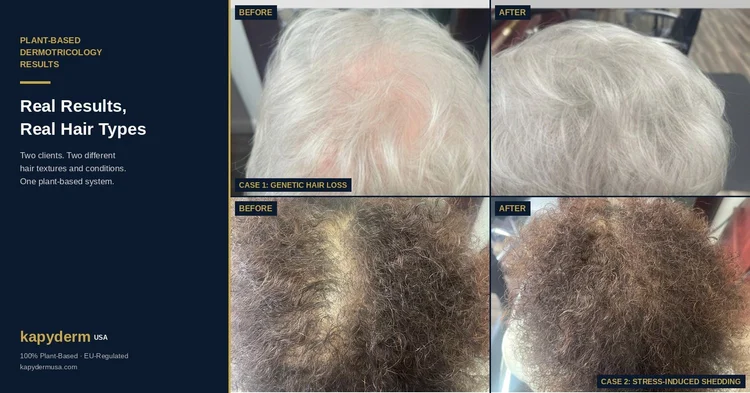
The Kapyderm approach to alopecia areata rests on being clear about a limit: no topical or supplement product can stop an autoimmune attack. What cosmetic scalp care can do is support the scalp environment during the unpredictable course of the condition, and address nutritional factors where they are genuinely present.
Topical — scalp environment support
- Alogenic Tonic — applied daily across the full scalp to support microcirculation and the delivery of oxygen and nutrients to dormant follicle bulbs
- Ampoule DT — applied twice daily to affected areas; the most concentrated localized component in the topical routine, used to support the scalp surface at the patch site
- Hair Loss Base Cleanser — clears follicular congestion so topical actives are not left sitting on the surface
Internal — where the evidence actually points
A 2025 meta-analysis of 34 studies covering 4,931 participants found that people with alopecia areata have significantly lower serum vitamin D and zinc than controls, with vitamin D deficiency associated with roughly two and a half times the odds of alopecia areata. Serum copper showed no significant difference.[13] A broader review of micronutrients in alopecia areata reached a compatible conclusion — vitamin D, zinc and folate tend to run lower in AA patients — while explicitly noting that the evidence is conflicting or insufficient for iron, vitamin B12, copper, magnesium and selenium.[14]
The practical implication: if you have alopecia areata, it is worth asking your physician to check your vitamin D and zinc rather than supplementing blind. Broad-spectrum supplements are not a substitute for knowing your own levels.
- Shock Ecology — a certified-organic green superfood formula (organic Spirulina 505mg, Chlorella 333.3mg, Moringa 166.65mg per 2-tablet dose) providing a broad plant-based nutrient base. It is not a targeted vitamin D or zinc supplement — if a deficiency is confirmed, that should be corrected specifically, with your physician.
- Depure — green nettle, dandelion, boldo, fumitory and peppermint; supports liver and digestive function.
Frequently Asked Questions
- The Multi-Faceted Role of Gut Microbiota in Alopecia Areata. Biomedicines 2025;13(6):1379. (Immune privilege, cyclical collapse, and gut–skin axis.) doi: 10.3390/biomedicines13061379 · PMC12189539
- Zhou J, et al. Janus Kinase Inhibitors for Alopecia Areata: A Review of Clinical Data. Front Immunol. 2025 May 13;16:1577115. doi: 10.3389/fimmu.2025.1577115
- Pfizer. Alopecia Areata Overview. Citing National Alopecia Areata Foundation data: 6.8M US / 160M global. Pharmaceutical company page citing an advocacy organisation — not primary research. pfizer.com
- American Academy of Dermatology. Alopecia Areata: Diagnosis and Treatment. Patient-education material from a professional body. aad.org — alopecia areata
- Lipner SR, et al. Alopecia Areata: A Clinical Review of the Changing Landscape with JAK Inhibitors. JAAD Reviews, 2025. JAAD Reviews 2025
- Epidemiology and Burden of Alopecia Areata: A Systematic Review. PMC4521674. Twin concordance and family history data. PMC4521674
- Comparison of Current International Guidelines for the Management of Alopecia Areata. Int J Mol Sci 2025;26(17):8632. doi: 10.3390/ijms26178632
- Cutaneous and Gut Dysbiosis in Alopecia Areata. 2025. PMC12173129
- Gut Microbiome, Metabolome and Alopecia Areata. Frontiers in Microbiology. 2023. doi: 10.3389/fmicb.2023.1281660
- Hirpara M, et al. Microscopic Colitis in Alopecia Areata: A Gut-Skin Connection Beyond the Follicle. J Drugs Dermatol, 2025. PMC12510172
- Senna M, et al. Long-Term Efficacy and Safety of Ritlecitinib: 3-Year Results from ALLEGRO Phase 2b/3 and ALLEGRO-LT. Am J Clin Dermatol. 2026 Mar 31. PubMed 41917311
- Qi Z, Li Y. Safety of Oral JAK Inhibitors in Treating Alopecia Areata: A Systematic Review and Network Meta-Analysis. Front Pharmacol. 2025. doi: 10.3389/fphar.2025.1576553 · PMC12375599
- Wu, et al. Association Between Serum Trace Elements Level and Alopecia Areata: A Systematic Review and Meta-Analysis. Journal of Cosmetic Dermatology, 2025. 34 studies, 4,931 participants: serum vitamin D (SMD −0.93) and zinc (SMD −0.69) significantly lower in AA patients; vitamin D deficiency OR 2.48 (95% CI 1.47–4.17); no significant difference in serum copper. doi: 10.1111/jocd.16740 · PMC11683520
- Thompson JM, et al. The Role of Micronutrients in Alopecia Areata: A Review. Am J Clin Dermatol. Vitamin D, zinc and folate tend to be lower in AA patients than controls; evidence conflicting or insufficient for iron, vitamin B12, copper, magnesium and selenium. PubMed 28508256
Fourteen sources. Twelve are peer-reviewed studies or reviews; reference 3 is a pharmaceutical company page citing an advocacy organisation and reference 4 is patient-education material from a professional body — both labelled above. Last reviewed August 19, 2026.
Your Follicles Are Still There.
Let's Support Them Through This.
The Kapyderm Alopecia Areata Home Treatment supports the scalp environment and follicle nutrition — plant-based, EU-regulated, no steroids or immunosuppressants. It works alongside medical care, not instead of it.